
Flashbacks of Memories to be Forgotten
Everything I hold onto has a purpose; a lesson. When the purpose has been fulfilled—mastery gained through practice, with patience and discipline—I perform a ritual to prepare the body for release.
A Ritual of Release & Forgiveness
I sealed this shoe box with a promise not to open it until after the publication of I’m Not Wearing Any Pants: Undressing a Diagnosis, expected in 2026. Primary drawings of a flattened pair of pants, and a skirt that looks more like broccoli than clothing, childishly decorate the lid. The brand of shoes belong to Katy Perry, a significant figure in my 20s and 30s, through marriage and divorce. The alter-ego rebelliously deconstructed her Christian beliefs in the digestible form of pop culture.
I can grow up and away from this, too, in my own way; I can be a person separate of the people who thought to create me to be
a person separate of the people who thought to create me to be a person separate of the people who thought to create me to
be. now i /\m: creator
I all but forgot what the box contained, which was the point. These were things hidden from sight so they might also be hidden from mind; things that trigger living memories and ignite the body.
what is concealed must be healed
i /\m: forgiven
I decided to open the box early to aid the book editing process.
The compiled manuscript—only a fraction of 24 year’s worth of journaling across print and digital mediums—sat at a hefty 675,000 words; the cutting room floor has only seen 158,000. The shoebox content helps me, as writer, identify where to focus the editorial eye next.
A glass candle wrapped in a True Reflection affirmation from 2021 tied with a red and white thread.
she is love. this is my true reflection. she is an artist. she is unafraid to love who she loves. she is unafraid to share her love and voice and process with all who choose to listen. she waits patiently, with wisdom and discernment for the invitation. she loves her shadow, and the secrets we share in the in between—for only us. she is slow and graceful: methodical. she can be quick and clumsy: joyful spontaneity! she has good posture and composure: she moves! she is an old soul and she is innocent. she lives the life she loves because she knows her worth and her value. she knows what she needs, what she wants, and expresses without apology. she is a dew drop and she is a storm. she is the rose petal and she is the thorn. she is wise and drinks from the fountain of youth. she is true.A palm-sized gold framed school photo of me at 12-years old; <f/>other’s favorite. It sat on his desk for years. I took it when I last lived with him, during Covid. Who says the estranged aren’t sentimental? Does sentiment require hope? Hope for what?
The only bible I have is <m/>other’s from her youth, a graduation gift at the ceremony from The Order of the Rainbow for Girls, with gold-lined pages. Separate from the United Pentecostal Church, pre-<f/>other’s influence? The stack of bibles collected in my lifetime, I left behind—in a closet, with the parents, spiritual prison—those inscribed with notes from my ghosts, the inner children, and those gifted to me as a blessing: a bible <f/>other preached from, a bible <m/>other made notes in, and grand</m>other’s bible, dedicated to me with a poem on the day of my birth.
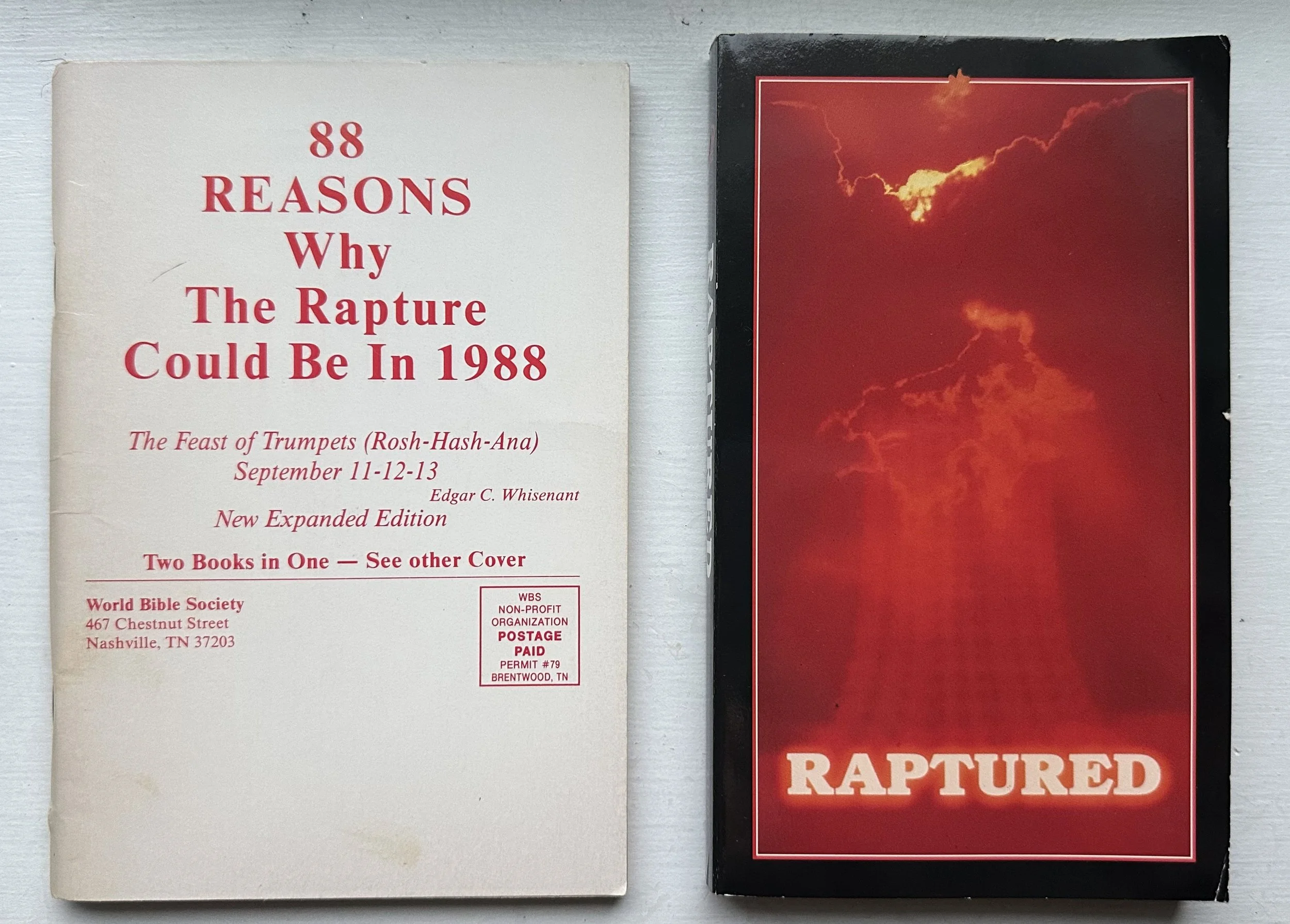
RAPTURED: A Novel on The Second Coming of The Lord by Ernest Angley, published in 1950, was handed to me by <br/>other. He was reading Stephen King but this wasn’t just another horror story. This was a novel interpretation of coming soon true events. By age seven, I had a healthy fear of the Christian apocalypse and I did not expect to live for long. The idea of the rapture and Jesus coming “as a thief in the night” terrified me, and I pretended to speak in tongues to save the soul—a lie that cloaked me in shame. I was consumed with survival and being good enough until I cracked on my 40th birthday because I hadn’t died yet. The End Times continue to drag out.
88 REASONS Why The Rapture Could Be In 1988 & ON BORROWED TIME (Two Books in One) by Edgar C. Whisenant is the booklet that circulated the UPC sect creating mass hysteria. I remember week-long revivals requiring daily attendance; I was baptized to cleanse the body of sin so I might get to heaven. <br/other did it and little sister wanted it too. There was no more time to be wasted. Hell is now.
All in the Name: How the Bible Led Me to Faith in the Trinity and the Catholic Church by Mark A. McNeil is the book my aunt Teresa bought for her three brothers to read and discuss with her. The author is a former United Pentecostal believer. We were all taught not to read what does not align with UPC beliefs; not all of us who did anyway abandoned religion, some changed teams; and some of us developed CPTSD with religion our kryptonite. Inside is tucked a blue feather I “found” on the Chehalis Western trail on the same day I read the story of the blue feather in the book Illusions: The Adventures of a Reluctant Messiah by Richard Bach. My aunt could appreciate what <f/>other can not.
A bundle of white sage to absorb harmful energy, paired with a white quartz for cleansing negative energies and promoting spiritual growth.
Underberg for digestion to ease the pain.
A rhino patch to remind of strength in sensitivities; one of the few remaining gifts from my ex-husband.
A full matchbox from Anna’s in New Orleans where unconditional love sparked.
A collaged rock to ground me in creativity.
A hexagon Orgonite to generate safety and compassion, achieve balance, and relieve homesickness.
A potpourri coffin scented with peace and gratitude.
These are items only I can apply meaning to and transfer power to control my beliefs. With these items in symbolic ritual, I strike a match and true love wins; the hell fire that threatens eternal damnation combusts the body to ash.
i /\m: present
I’m Not Wearing Any Pants: Undressing a Diagnosis is the only book I ever wanted to write before I die.
Some in my family believe that personal journals must be burned before death or left in the will to someone who will burn them with immediacy post-death; privately penned thoughts of the dead, meant to stay hid, off limits to the living. As a memoirist, I am diametrically opposed; thoughts released in a stream of consciousness can be a great teacher, identifying lessons outstanding and revelations. As a Gurley descendant, I will publish what I can before I die.
The debt is paid, this life is forgiven—the devil, released—to be lived. The soul will rapture when the body completes the cycle of living. May the publication of I’m not Wearing Any Pants: Undressing a Diagnosis end the spiritual torment and may death hold no secrets under lock and key.
i create the conditions to lessen the power of the triggers
these flashbacks of memories to be forgotten.
Crucify me, I don’t care.
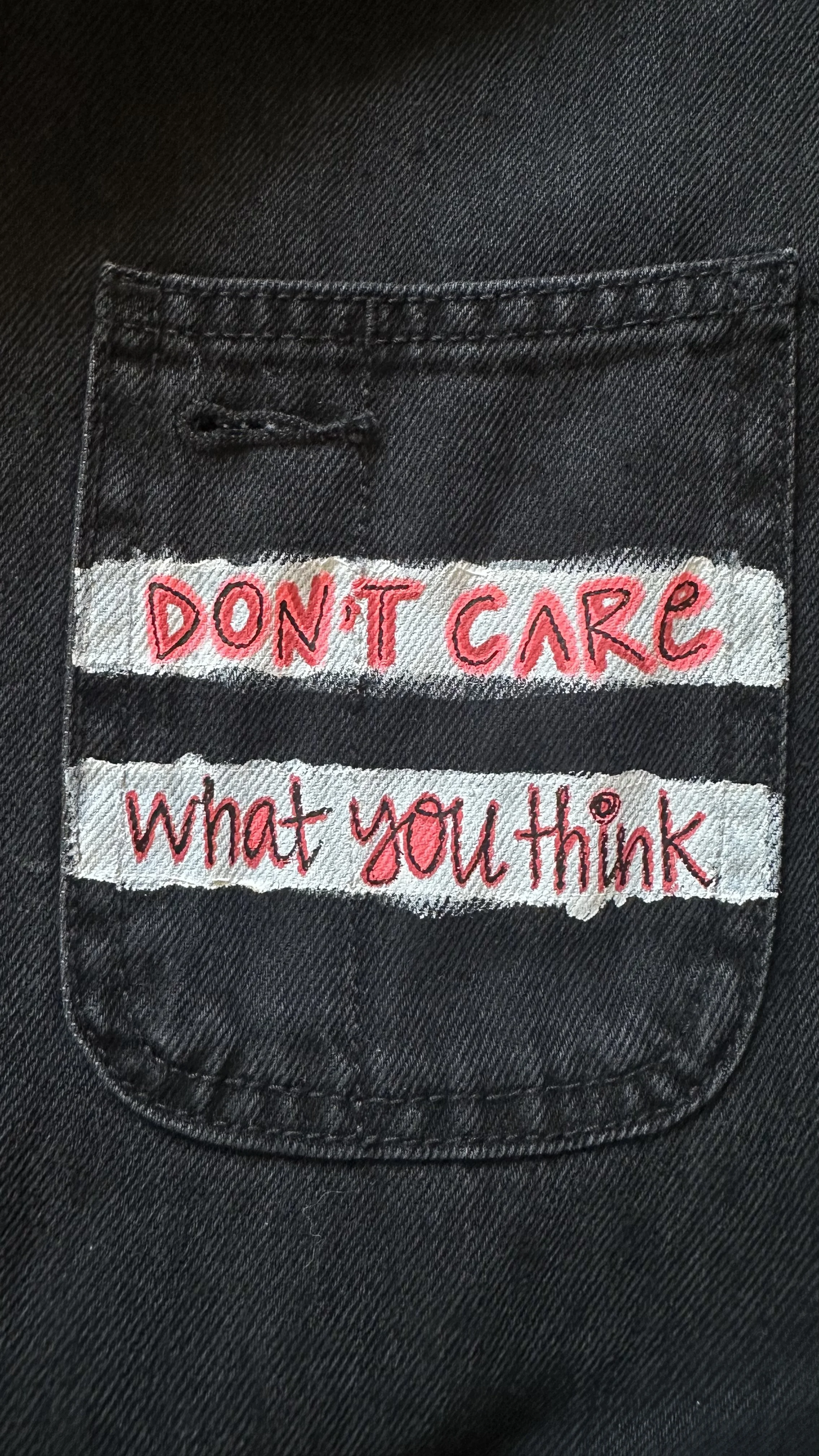
don’t care what you think
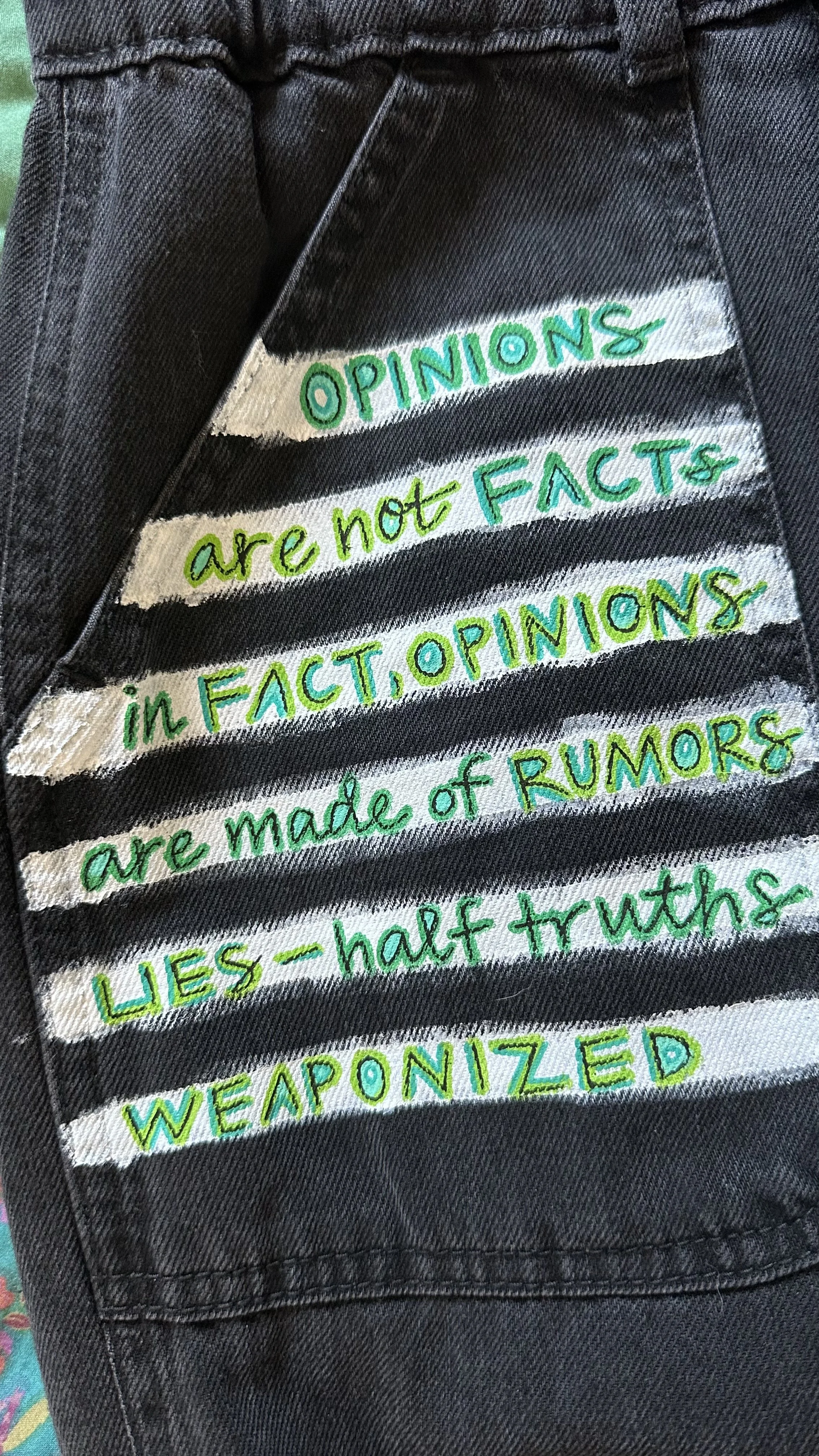
opinions are not facts in fact, opinions are made of rumors, lies—half truths weaponized
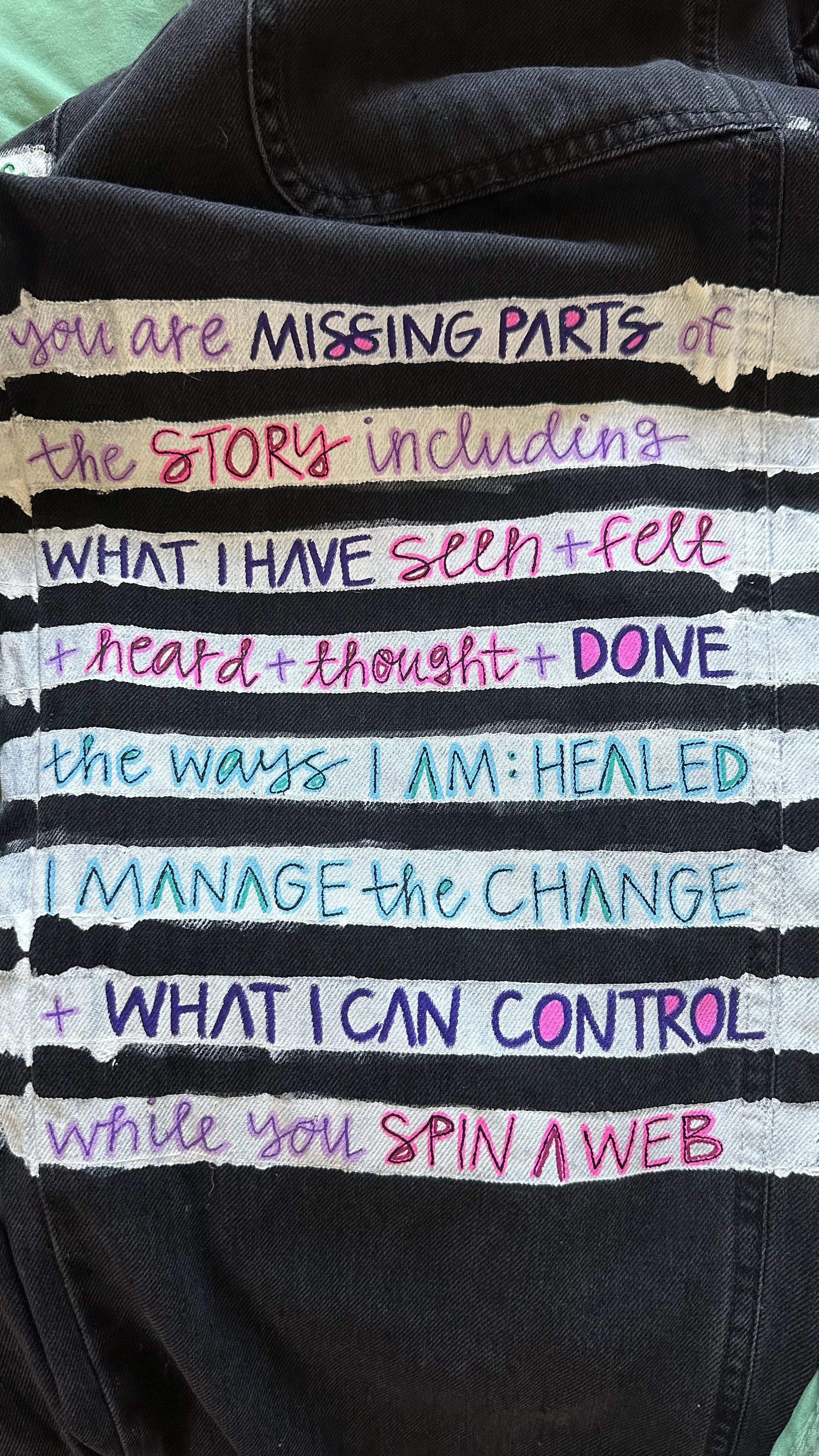
you are missing parts of the story, including what i have seen and felt and heard and thought and done; the ways
i /\m: healed
i manage the change and what i can control
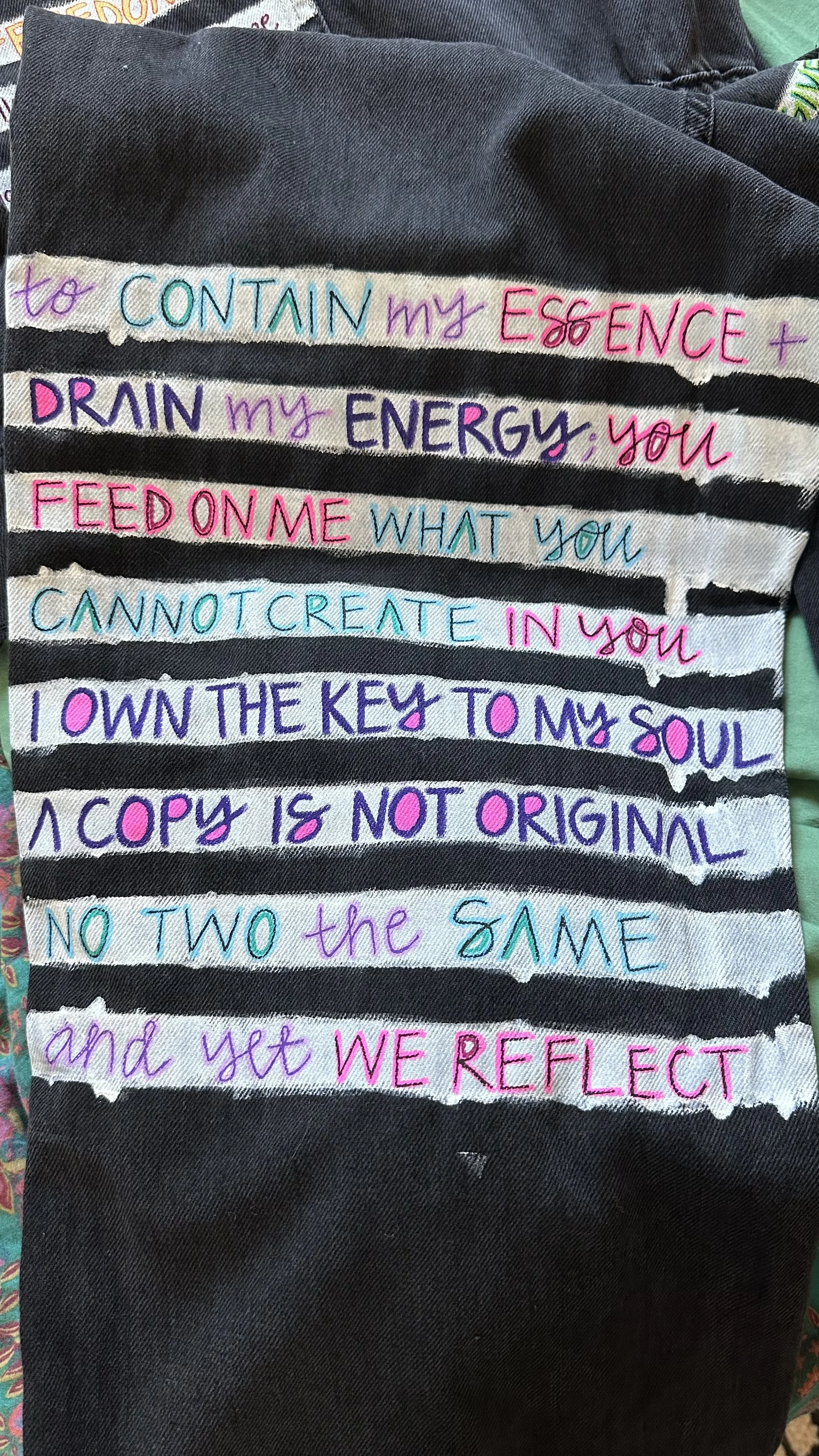
while you spin a web to contain my essence and drain my energy;
you feed on me what you cannot create in you
i own the key to my soul
a copy is not original
no two the same and yet
we reflect
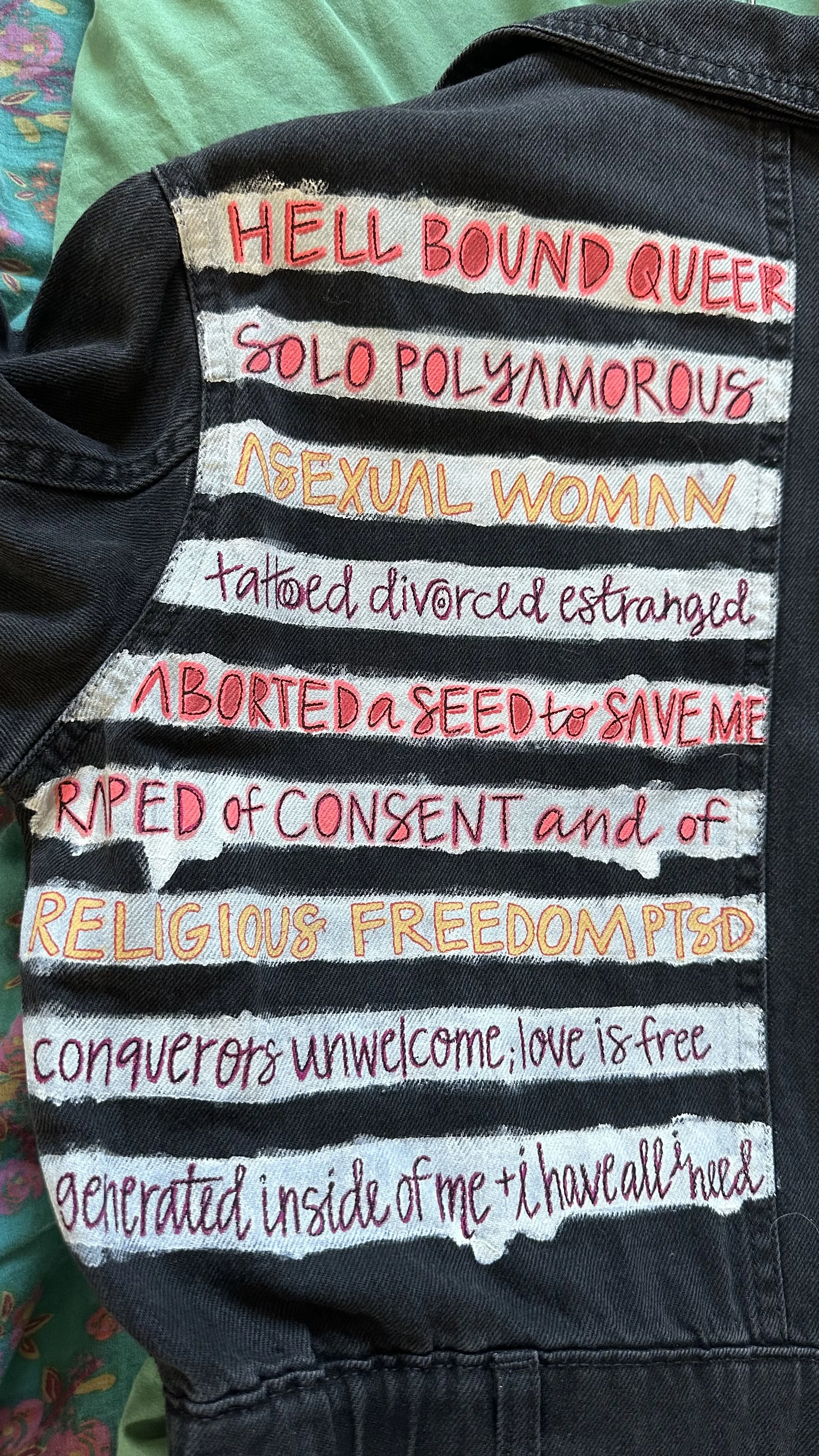
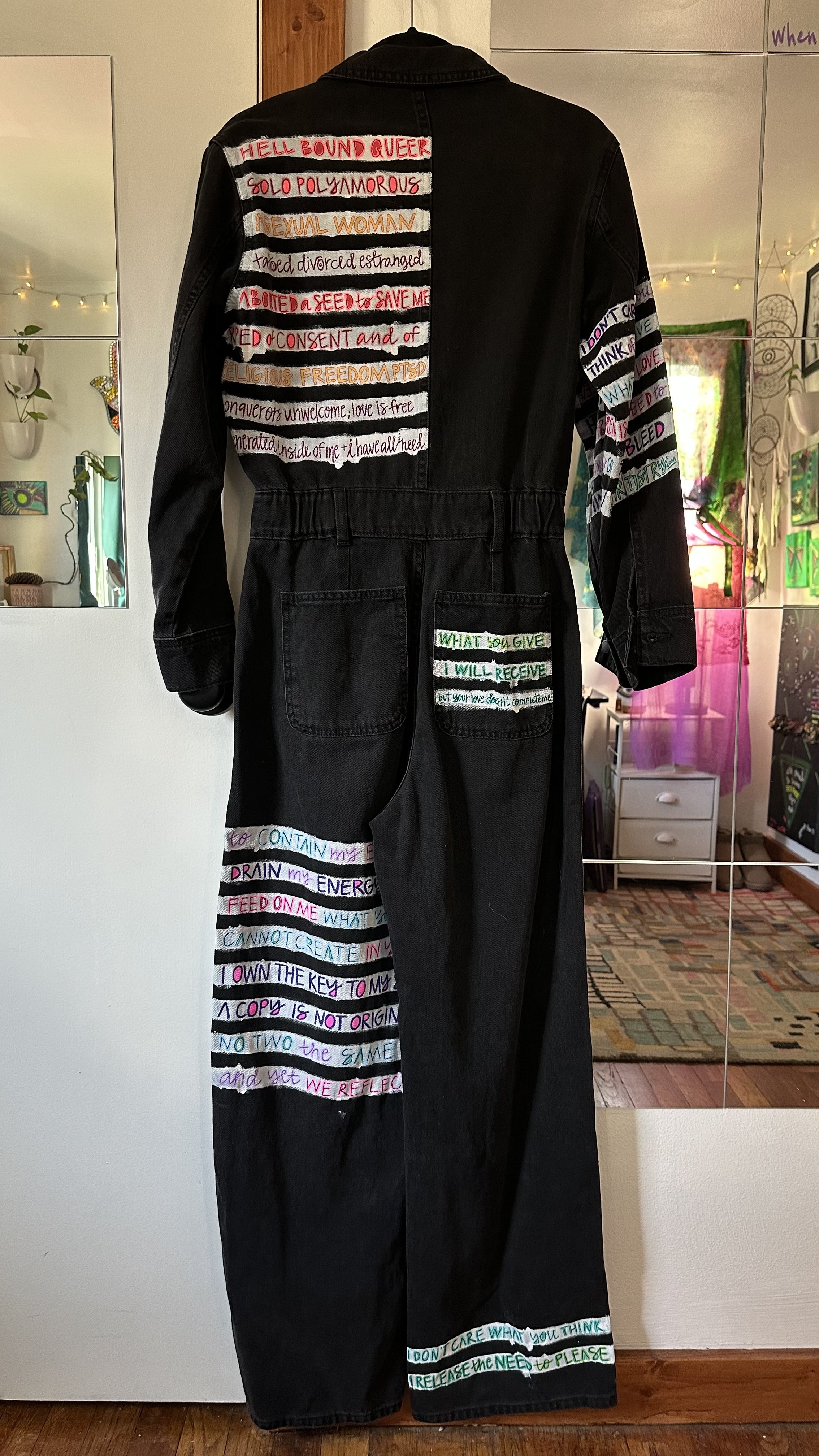
hell bound queer solo polyamorous asexual woman tattooed divorced estranged aborted a seed to save me raped of consent and of religious freedom PTSD
conquerors unwelcome;
love is free
generated inside of me and i have all i need
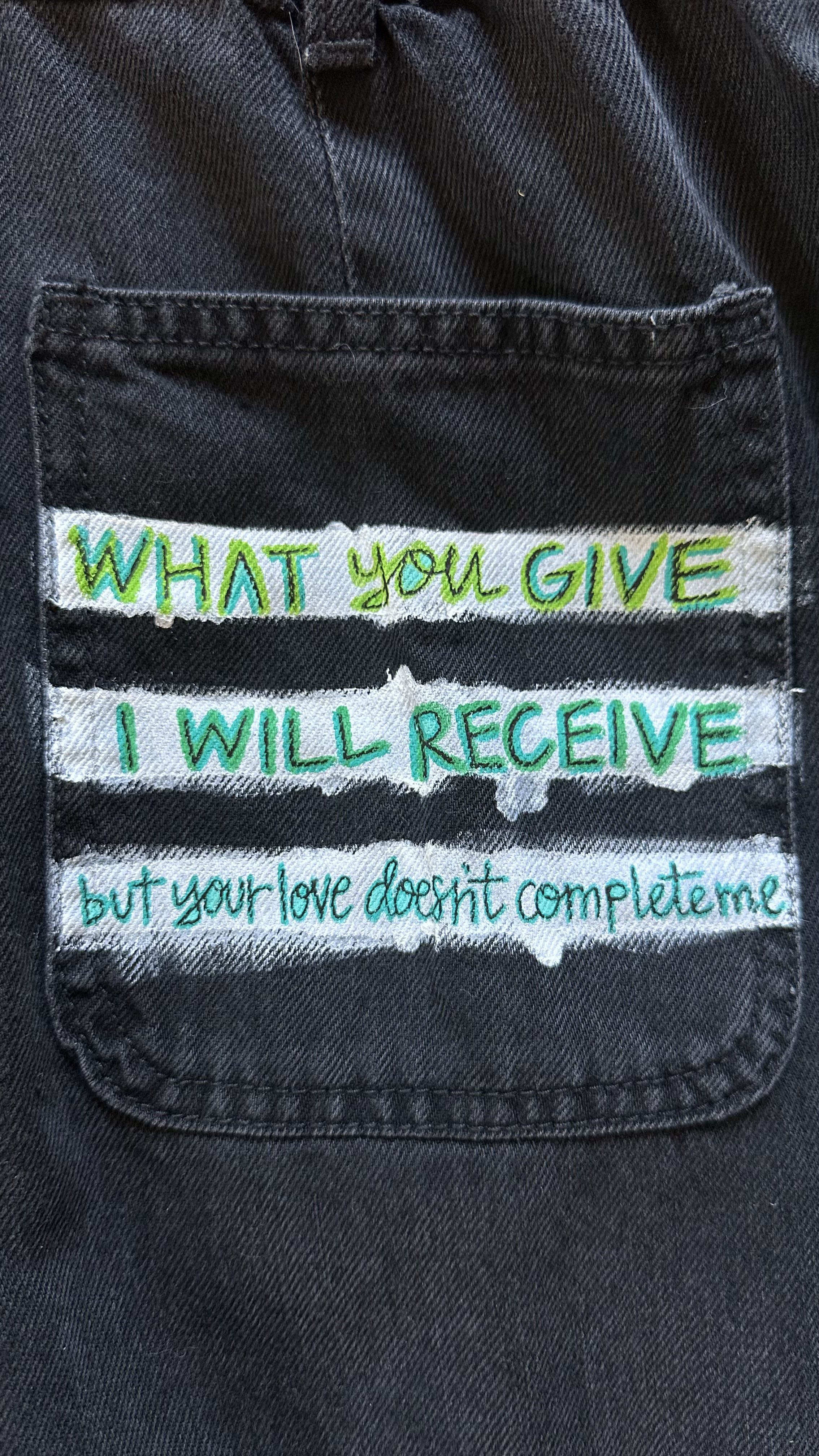
what you give i will receive but your love doesn’t complete me
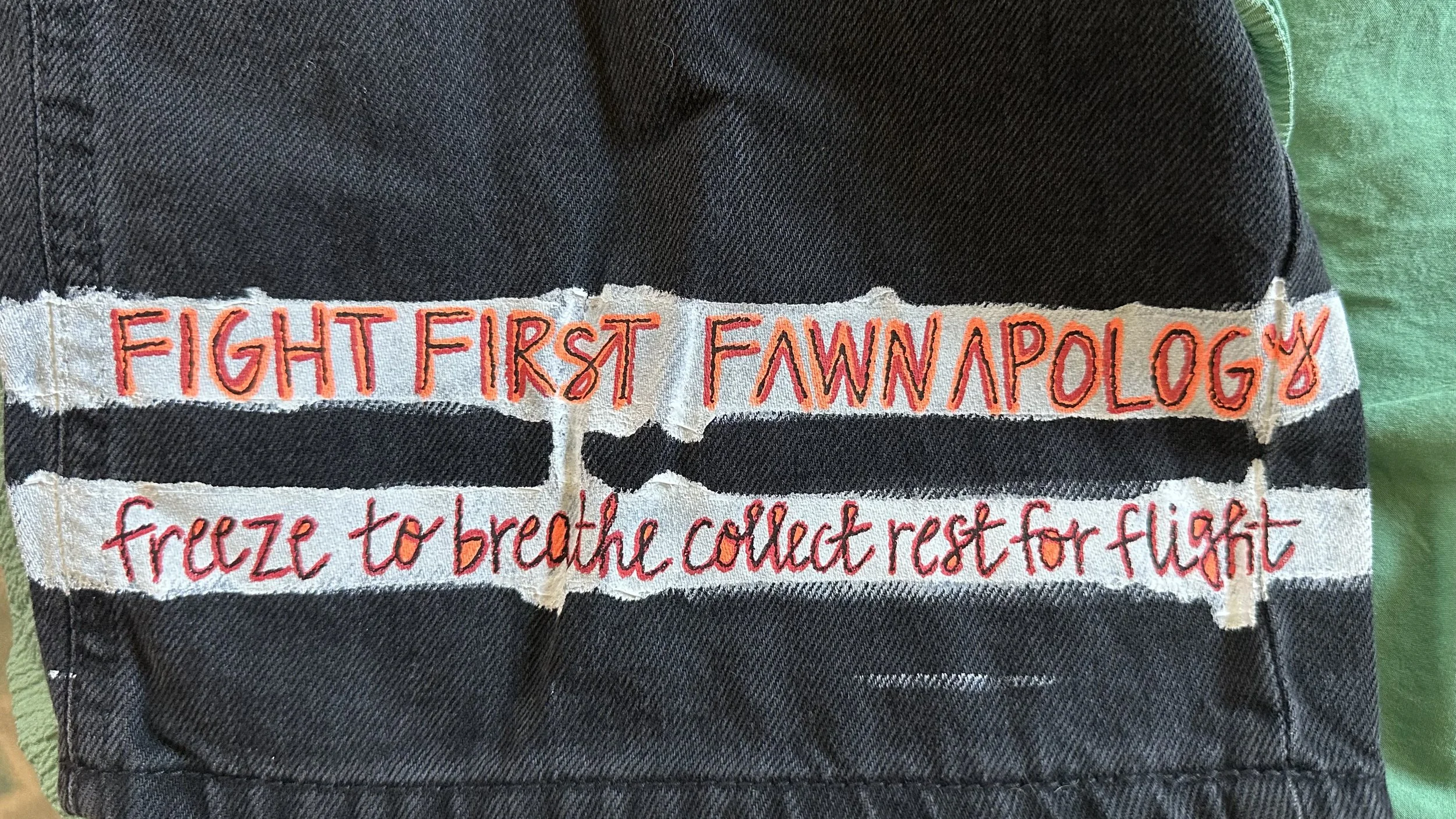
fight first fawn apology freeze to breathe collect rest for flight
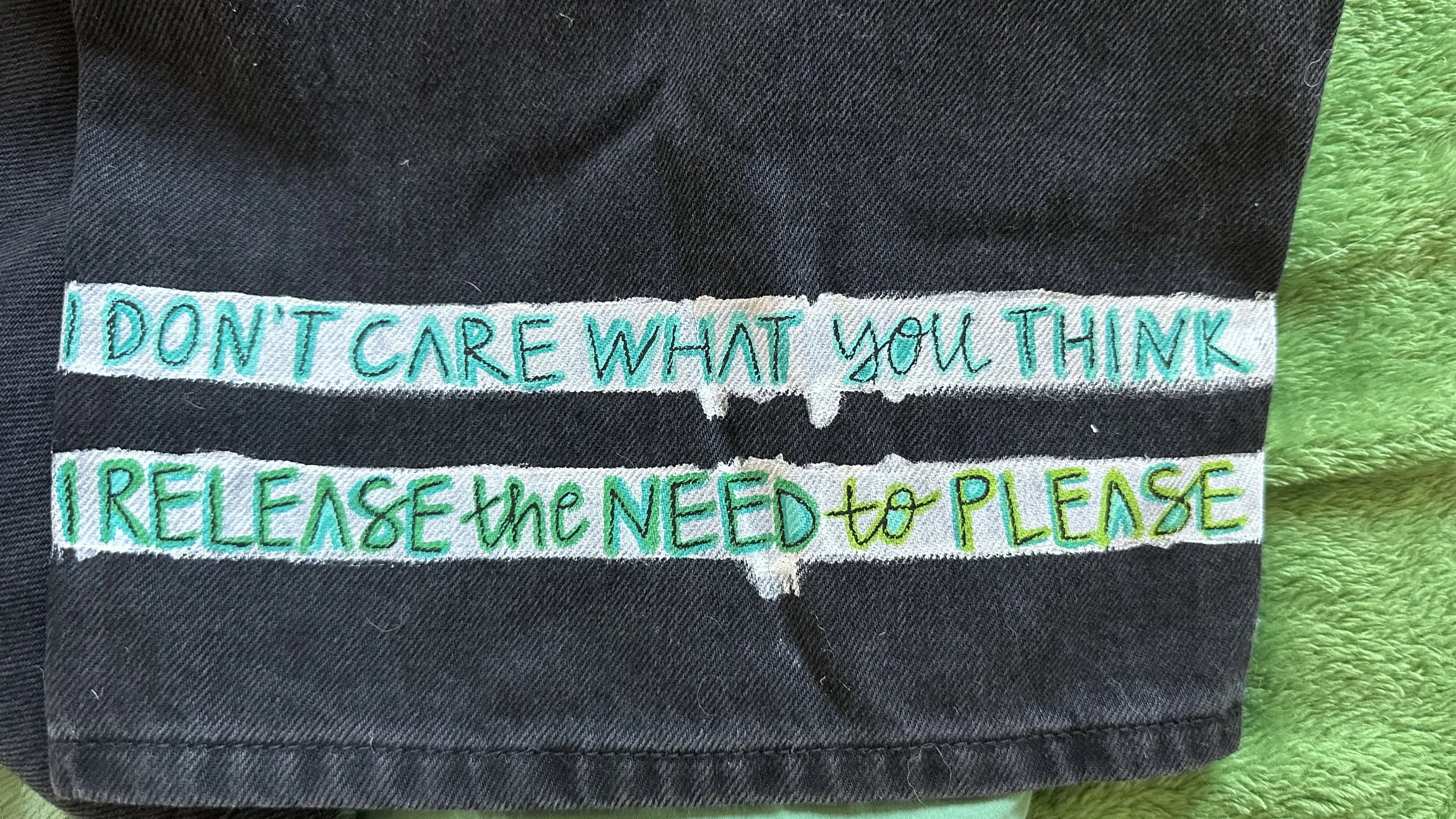
i don’t care what you think
i release the need to please
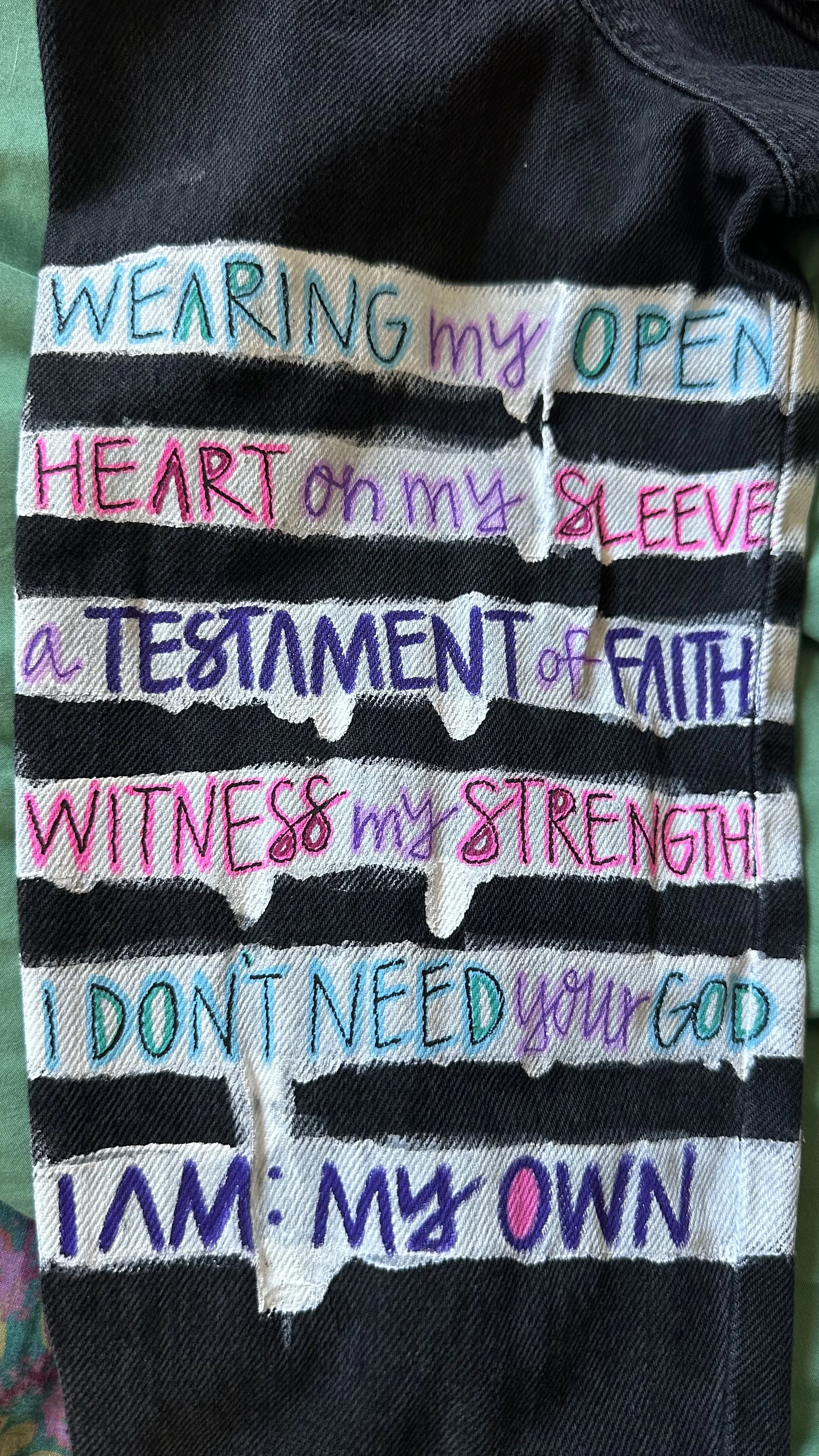
wearing my open heart on my sleeve
a testament of faith, witness my strength
i don’t need your god
i /\m: my own
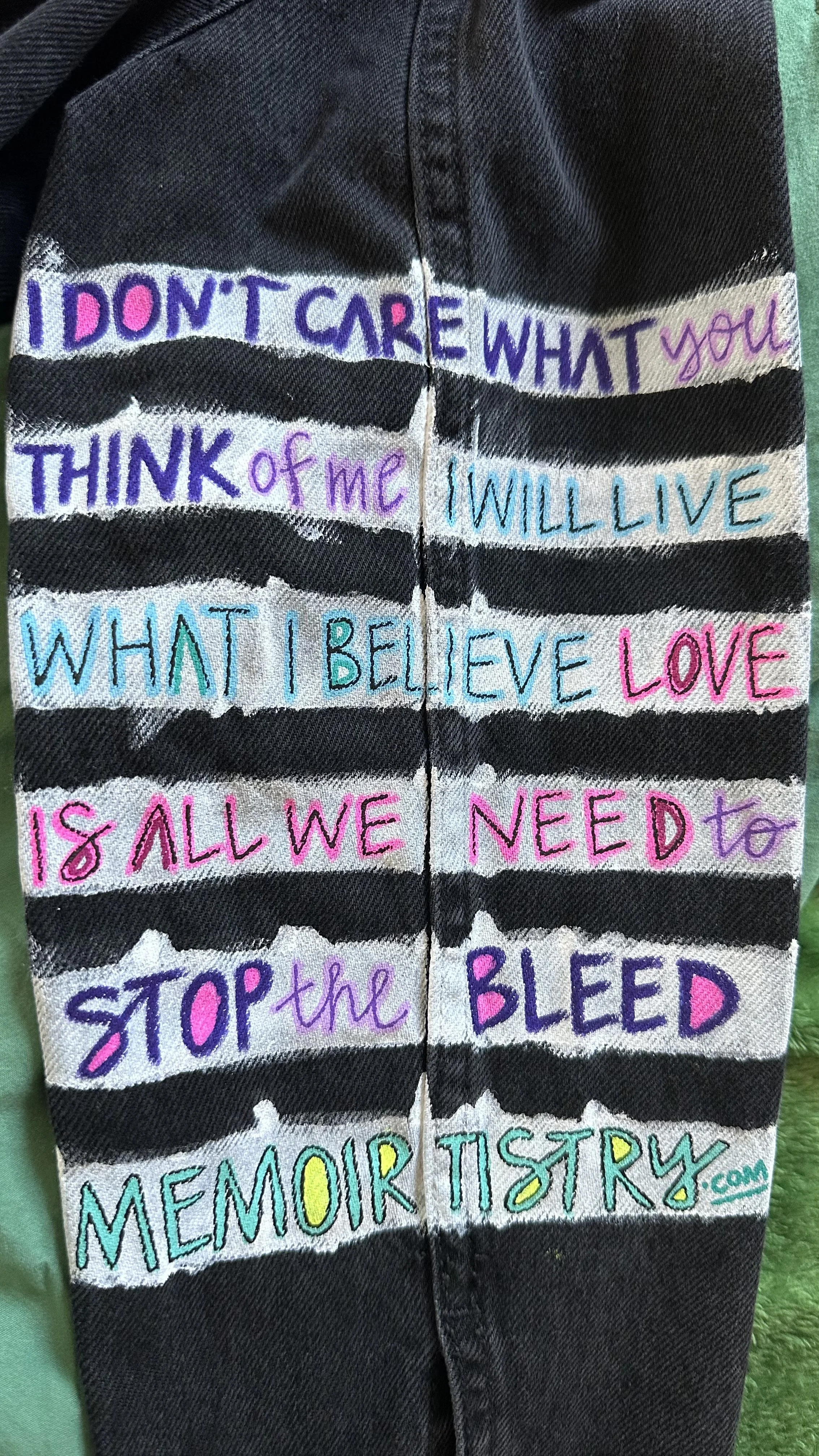
i don’t care what you think
of me
i will live what i believe
love is all we need to stop the bleed

I throw myself on the sword of contradiction and I do not die. Secrets revealed cauterize the wound. The truth will set you free, or so we say. The truth has made me an island with limited passageway.
The wisest words from the mouth of a man 10 years less in age. “I don’t care.”
Not to care sounded harsh on the ear and bitter on the tongue. Selfishness centered, implied.
selfish doesn’t matter
i /\m: the center
You don’t have to understand me to love me,
and i wish you’d try.
as he turns his back and walks away, she affirms his reaction. “when he says he doesn’t understand you, he really doesn’t.”
of her own inability to listen, even to words on a page. “it’s too difficult to read what you write.”
her tears do not wash away his sins.
misunderstandings linger in the air; it is too much life to pretend doesn’t exist because they do not consent to engage in hard conversations where they might experience “bad feelings”.
what of the bad feelings i experience? must i be alone with them? i am a ghost.
I grew up confessing my sins at a church altar, begging forgiveness with other members of the sect. I did not speak them directly to a person, but I did speak them out loud to Godman in the sky so those around me could hear if Godman blessed my tongues with the holy language that proves salvation. People don’t forget as easily as someone who isn’t real, the sins you are vocally repenting from. Those sins become identity; with every mistake, you will be reminded because you outed yourself in the practice of repentance, another step in becoming saved. Our sins branded us. I was exposed to collective grief of suffering imposed;
die daily, confess and be changed!
Adults’ writhing bodies, loose tongues nonsensical, exhaustive wailing; we could only dance with the holy spirit,
there is joy in this pain!
I spar with myself. We are wrong, and we have the right answer, but we cannot forget our wrongness. I was born into sin, and I am a special one, born into the “truth”. Being human is traumatic, sinful; and I cannot be anything other than human. Is life a losing game? The Jesus character proved that living by your own compass will get you killed. His death is worshiped, his followers addicted to losing their lives, consent to murder. Do not kill, a commandment ignored.
The hand painted black jean jumpsuit is a self-portrait.
White lines cut through the dark representing light, and lines of notebook paper. I stream my consciousness in color.
It has taken until my 40s to internalize not caring what others think. I lay hypervigilance on the altar, beside external perceptions, assumptions, interpretations and expectations. The anxiety lessens. I begin to highlight in me what gives another pause. I have nothing to hide when I am not pretending to be someone else. I cannot concern myself with ideals; I am only scared of heights when on a pedestal.
Wearing the jumpsuit in public draws others to me. I am commended for my bravery, uplifted in my artistry, and separated. You love me until the words become clear. The expression haunts, and that is the point. We cannot get away from ourselves, so I choose to run toward myself because I am with me all the time.
when i /\m: with me
i /\m: saved
So no, I don’t care what you think,
even if it kills me like it did that prophet.
History isn’t Destiny: Three words make a sentence.
I haven’t spent a morning with a book in months; there is no time for leisure pursuits. I reprimand myself for being still in body and empty of thought—motionlessness, a sin. I self-medicate with distractions “to turn my brain off,” though my preference in waking life is mindfulness. Who am I kidding? The voices ruminate as a tape on loop. I cannot escape myself and I cling to dissociative tendencies.
A brief meeting.
I met Catherine Gammon on Sunday, October 12, at City of Asylum for Books & Bistro, a gathering of local authors, poets, and independent publishers. There was promise of connection, which is why I attended, though these events usually serve to remind me how alone I can feel in this craft. I do not understand all the reasons I shy away from creative spaces, except to say I struggle to “know my place,” and contrary to popular opinion, I am quite frightened of recognition in real life. My talents have been squandered, so I have grown the belief I must keep them to myself while also harboring a desperation to be seen.
Gammon is nearly twice my age. I first saw her read at Bottom Feeder Books, on the evening of August 30, from What is your work? published by Almost Perfect Press. I was drawn to her immediately because of her whitened hair; I am intrigued with aging, less afraid, when I witness older women engaged in the arts. From where I sat, underneath a table, the small room crowded with bodies emitting smells of sweat and camaraderie, my knees tucked into my armpits, I closed my eyes and, when Gammon spoke, I imagined her presence as my future. Like her, I will grow older; like her, I hope I continue the work.
I approached Gammon at her table in City of Asylum, excited to see her. She had left Bottom Feeder before I was able to ask for a personal inscription in my copy of What is your work?. “I saw you a few weeks ago, at the Almost Perfect Press book release.”
Unsurprisingly, the sentiment she shared in response was familiar. I do these events but they are quite nerve-racking. I agreed. Many writers appreciate the opportunity to share and have a bent for privacy. I enjoy when I can be familiar to many and known by few. Writers reveal the stories we tell ourselves. It is not difficult to find those willing to relate when your words are clear and unavoidable.
I spoke with Gammon of the other books she had on display. On the back cover of Isabel Out of the Rain, published in 1991, was a portrait of Gammon. I asked her what it was like to have a book published so many years ago, and how she was connected to it now. What did it feel like to see herself as she was then, a young writer? The manuscript is on a floppy disk somewhere. I have thought about revisiting the work and making some edits. She inferred she would have no idea how to bring it back to life except to use a printed copy to create a file she could manipulate. Without hesitation, I offered that if she gave me a copy of the book, I would do it for her. “And I type fast.”
She commented nothing of her age and the 34-year old portrait, except to say she was in her 80s now. We exchanged information and she emailed me a few days later to thank me for the offer. She would consider it when she was ready to move forward with Isabel.
History isn’t destiny.
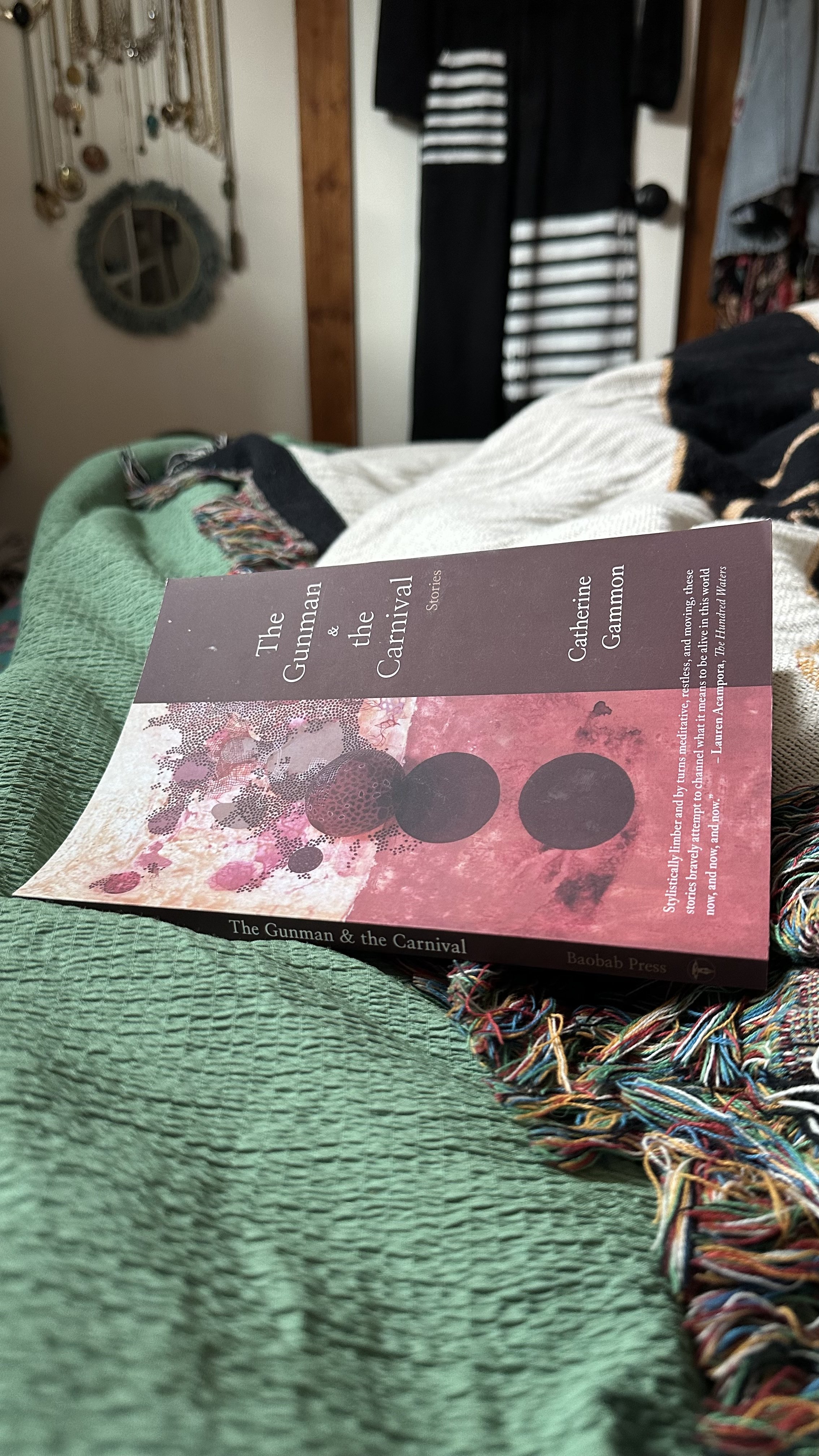
In the post-Thanksgiving lethargy, I was moved to read The Gunman & the Carnival while drinking coffee in bed. I lingered over Gammon’s handwriting and my first name written in proper, hurried cursive. “I hope you enjoy it,” signed, Catherine Gammon.
The coffee never stays warm enough because consuming words fills me up. I reheat in the microwave but the coffee doesn’t taste fresh, and my mouth is bitter with morning breath. The tongue is dirty, and I have a clear mind; the brain a sponge. On page 16, in A Vampire Story?, a single sentence stands out from the rest. “History isn’t destiny.”
Inspiration tickled my creativity but I told myself to keep reading. It is rare to find a book I have read that does not include underlines and highlights and notes in the margins. When I finished the editing certification program at University of Washington, Seattle, in 2018, the editor in me came alive and shadowed the writer in me, who could read for pure enjoyment. I read 11 more pages before scratching the itch. Extracting a single sentence from someone else’s work is a writing practice that helps me mine for deeper understanding of self.
I dialogued with my past,
it is true i feel relegated to past versions of myself, as if i owe her something. she wonders when i will grow wise to my own nature. she sees my tendency to hide and keep secrets—to live up and into another’s ideal silently, accepting the stories they weave and trying to fit herself into them. i am as beautiful as they say, but she never lets it go to my head.
“i couldn’t if i wanted it to,” i tell her.
she nods. “it’s your dad’s fault, and your mom’s, you don’t believe. and what if you could?”
“i know, i know, the blaming ages me. what of forgiveness?”
“you don’t have to give it to them, only to yourself.”
“what’s in it for you?”
“death.”
“i am not ready to die, though i think of it often. i picture what i might look like when i am stiff.”
“death is not rigid.”
“oh, you are going to tell me it is peaceful. you know that only makes me want it more.”
“i don’t blame you. the only way i will disappear is when you forgive yourself for not being perfect. otherwise i will haunt you forever.”
“and forever haunting is something i shouldn’t want? it’s nice to know i will always have company.”
and shared the piece with Gammon.
When the stream-of-consciousness quieted, I emailed Gammon. “I hope an unsolicited share isn’t unwelcome.”
I wondered if she might be interested in discussing writing over coffee or tea, before closing the note with my digital signature. I await response without expectation, only gratitude. Gammon’s discipline to the craft over the years has shown me a glimpse of who I might be when I “grow up,” and I don’t know anything about her journey. I don’t know anything of myself at 80, but I think I want to.
History only informs the future if we are unwilling to change now.
A Decorated Body
It is 1995, and I am 14 years old.
I’m sitting at the dining table with Cousin in one of my uncle’s homes. I whisper a confession.
When I grow up, I am going to be tattooed.
Cousin’s eyes became saucers. She excuses herself to report me to her mother, my aunt. Cousin is scared I am going to go to hell and needs to be soothed. I am scolded for saying things to confuse and hurt feelings; reprimanded for dreaming aloud about an adulthood of bodily integrity. The worst thing to be is a stumbling block, and I know better.
I am commanded to repent this sin against Cousin.
From the Tips of the Toes,
<br/>other told little sister a tale, and sketched the characters.
When unicorns jump into the ocean, they become narwhals; and if the narwhals surface, they are unicorns again.
On the right foot is Norbert the Narwhal, on the left, Nantucket the Unicorn; my “feet friends”. When I visit the beach, I dip the feet into the ocean, left-to-right-to-left-to-right, ritualizing the cycle from unicorn to narwhal. From life to life to the necessary and never-ending deaths.
This tattoo captures the innocence of childhood beliefs; a time of blind faith, when I may have trusted <br/>other to tell me the truth.
Around the Ankles,
Trying to be inconspicuous, at the base of a hot air balloon’s basket, a bat escapes into the night, surrounded by fireflies, with a stolen eyeball in its grip.
Up the Legs,
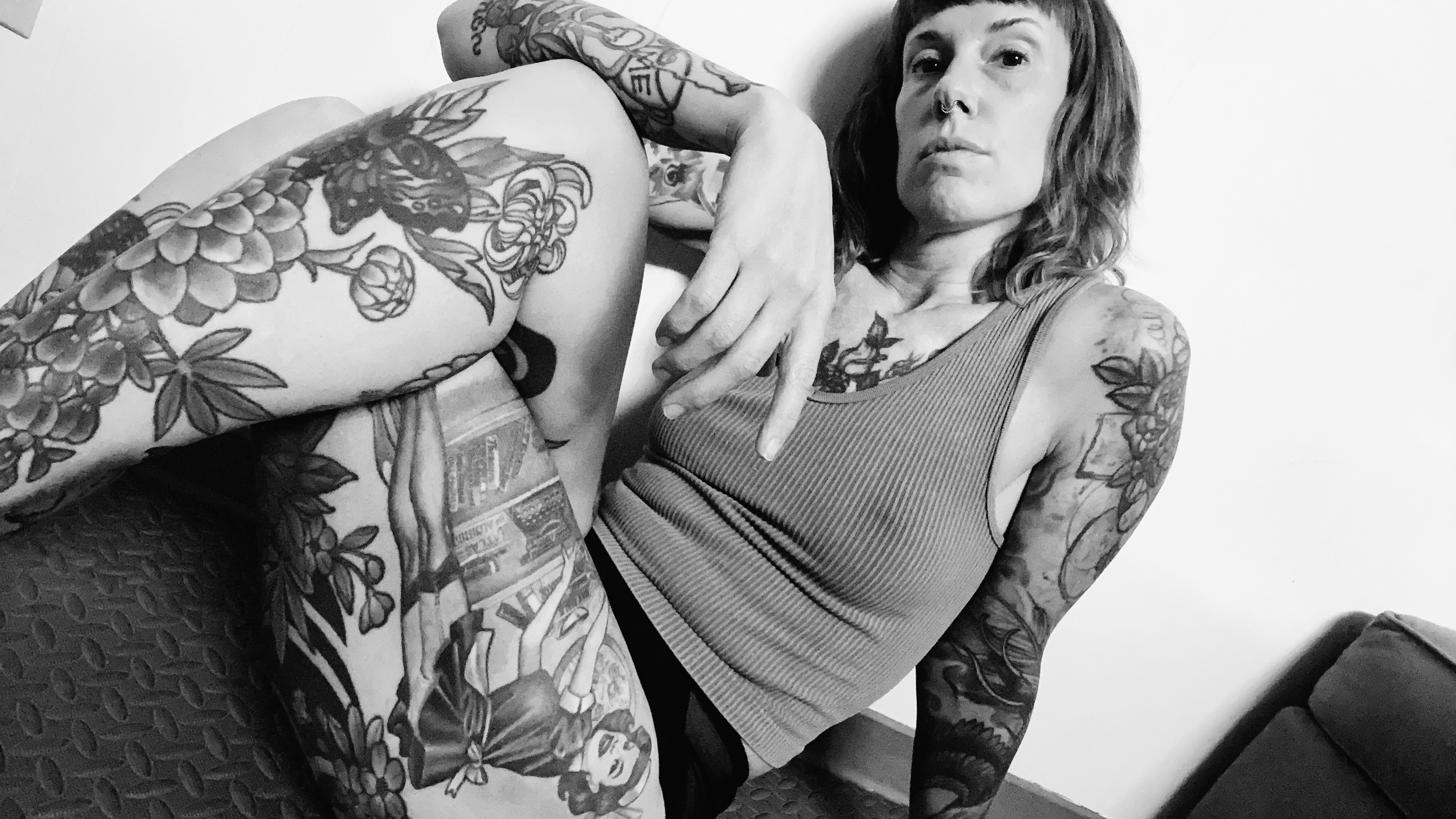
On the left calf, an Earth-bound astronaut in a hot air balloon made of the Universe, looks longingly toward a spaceship, attempting to beam him up. This tattoo expresses my relationship with <f/>other. He taught me to look toward the stars while limiting himself to black and white thinking. I tried showing him the way, from inside the spaceship, but he does not recognize how I have changed. And so <f/>other holds tight to his balloon, his beliefs, and dreams of adventure never far from reach.
Under my left knee is a black death moth in traditional styling; under my right, a colorful butterfly to contrast. Transformation unfolds my story. I am learning not to be scared of not being here any longer.
On my left thigh, a pinup-style tattoo; a portrait of my marriage.
I am dusting a bookshelf in a French maid costume with a white petticoat exposing a pink garter belt attached to black stockings. My hair is curled, and my lips a cherry red. I’m stuck in 1950; who wears high heels to clean? Hanging above my head is a framed portrait of my cat, Pixel; behind me is a round painting of pastel roses. I am smiling over my shoulder, toward my husband, who would be positioned on the couch with an Xbox controller in hand while I clean the house top to bottom, room to room. He’d eat snacks, drink whiskey, and lift his feet when I ran the vacuum. I am a perfectly obedient and appropriately sexy fantasy of a real wife. Displayed on the bookshelf, a Corona typewriter and a curated collection of books. Time and sun have blown out the letters and it is becoming difficult to read the titles. The HOLY BIBLE is in clear view, however, and stacked underneath is the book I am writing now 10 years later: I’M NOT WEARING ANY PANTS.
On my right calf, a grayscale garden skull made of flowers and leaves, with white accents, covers up the first hot air balloon tattoo. The first balloon was drawn by my ex-husband but he “hated looking at [the artist’s translation of his design]”.
When he complained, all I heard, that he could never understand, was “your calf is ugly, erase it”.
Expert eyes can make out the ghost balloon. Absence haunts.
Below the skull, a scene: three bats; one plucks an eyeball from a Mason jar, and two others approach in the distance. They fly across a night sky filled with fireflies who leave a glowing trail, a message, on the base of the ankle: “following intuition”. This is how I move forward, one step at a time. I do not require the eyes to see.
Beside the right knee, above the skull, is a ruby gem in the shape of a heart with a scripted bye. July birthdays; a farewell to friendship.
Watching from my right thigh, facing ahead and rich with color, an ornately framed portrait of an ambiguous figure sharing eyes and bending gender. A woman with her hair piled atop her head presents her femininity forward while a bearded man stares back at me, beckoning my masculinity. I mirror him and reflect her; we are one in the same. Who do you see when you see me?
A dove lands on my right hip with a twig in its grip, signaling peace and new growth.
and Up the Arms,
On the left wrist I am adorned with five hash marks. At once, a celebration and sentence, of five years of marriage.
Facing the five is the Phoenix rising from the ashes, smoke billowing toward the armpit. I do not look away from the messy parts and missteps. I embrace this life-death-life cycle because I want to change; because I want to change I embrace this life-death-life cycle.
I wear my heart on my (left) sleeve to memorialize my relationship with <m/>other; a yellow rose with red-tipped petals and faded green leaves, plucked from a bouquet. Forget-me-nots (the flower of my birth state) hug the rose. Black-lined geometric shapes and dew drops are layered atop the flowers, with paint splatters of blue, purple, red and yellow framing the chaotic pattern.
I color outside of the lines and she stays in. I openly express [to her], I do not want to hide as she hides from herself. When we are alone, I believe she can hear me and we sing in harmony. She is where I grew in creation, yet she cannot believe her own creativity. Am I not as stunning as you are beautiful, <m/>other?
On the right wrist, aunt Teresa’s script of Love, written inside the last birthday card I’ll ever receive from her. She has been my ancestral angel; an anchor to blood across time. I find her inside my grief. In death, she is patient with me, forgiving, and she is always with me. And so, in life, I can be patient with me, forgiving, and i /\m always with me. We must die to know i /\m.
Under Love, rests a pencil, a sharpener with shavings, and a Pink Pearl eraser. I write because I must. Beside the writing tools is a reminder to “be brave with your words”, and a rose compass without directional points—a perspective on presence. Wherever i /\m is where I’m meant to be. Where I am, is where i /\m is found.
Another five in morse code marking 10 years of marriage beside my right elbow pit.
The most popular tattoo is Pixel, my pixelated cat portrait, on my right bicep. She glares, and dares you to gettooclose.
Resting the right fist under the chin, the forearm exposes a request for a date to satiate with breakfast foods. Strawberries, blueberries and pineapple spill from a plate of syrupy pancakes stacked high, topped with a runny egg (the yoke often confused for butter), and stabbed with a fork. A knife hovers nearby, along with a syrup bottle branded BUY, a coffee cup identifying ME, and BRUNCH under the fruit. This tattoo inspires an activity.
I make eyes with someone. I tuck fist into chin, point to breakfast with left index finger, point to mouth, point back to tattoo and then point to person. It requires the skill of reading the eyes, which few have developed.
(I never use it. Turns out, I don’t care as much about dating as I thought I did.)
On the back of my right arm is a space- and Wizard-of-Oz-themed piece. There’s no place like home, but home isn’t Earth; “... my treasures are laid up, somewhere beyond the blue.”
Down the Head,
Behind the right ear, my handwriting; a word: “secrets”. Behind the left: “lies”.
Strangers tell me secrets and lovers tell me lies. The signal of a broken intimacy meter; the unfamiliar faces safer than the recognizable voices. Billy Joel was correct. I can ask for the truth but I’ll never believe you.
On the back of the neck, an eye with intricate detail and pops of color representing seven unblocked chakras. Creative flow opens me to consider new ideas.
I couldn’t locate a photo of me at age 14.
“wait ‘til you see her from the back-back-back-back-back…”
Across the Back,
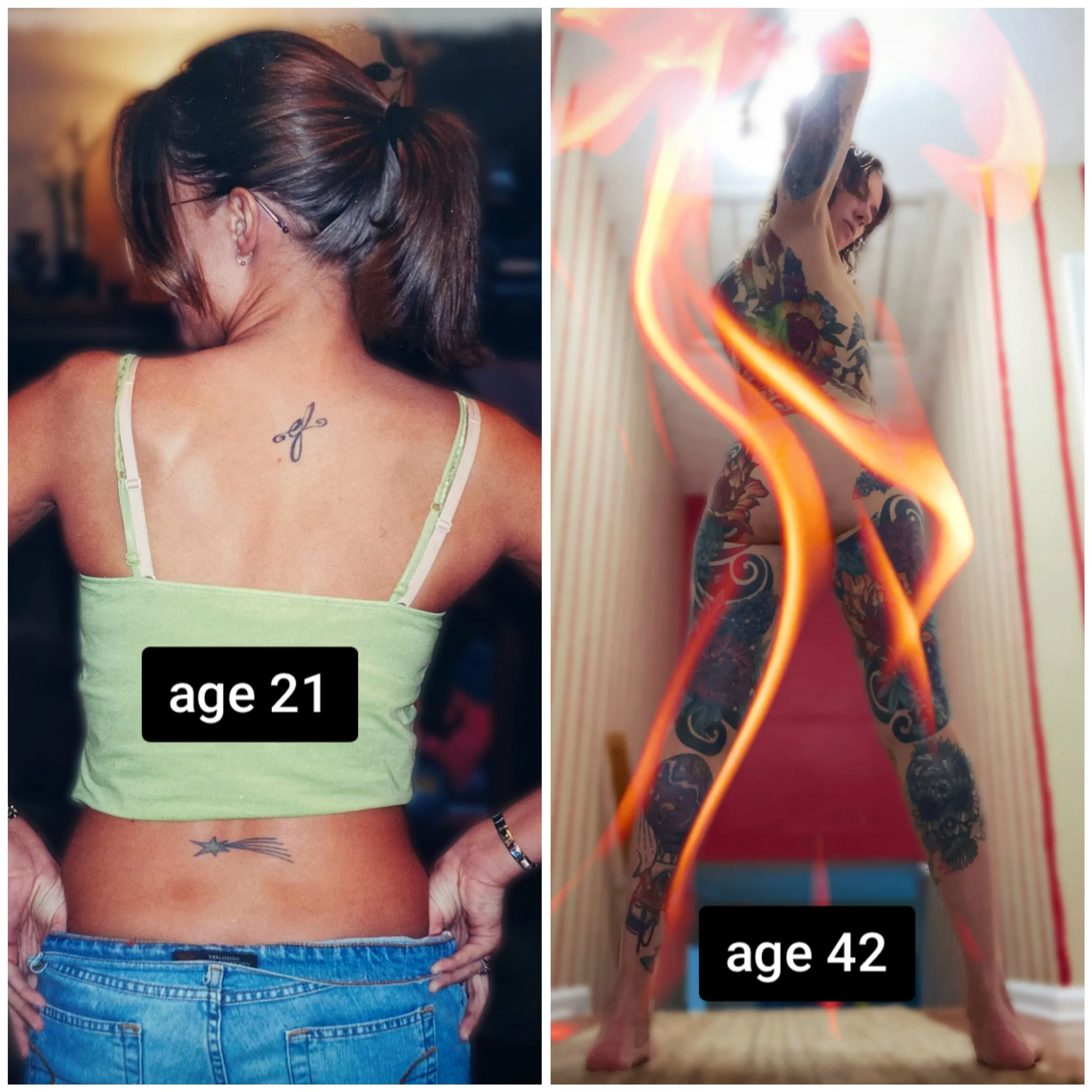
In between my shoulder blades, my second tattoo is covered by an apple. Inside the apple, a delicate edg in my own penmanship hides. Underneath the apple, my married initials: eve. Divorce led me back to edg, but I will leave eve be. She has had enough. Nothing is her fault.
Circling the apple were once two sparrows, red and blue. The red remains the same but the blue has transformed into a crow–a callback to tattoo number one… “for sorrow, two for joy…”
The first tattoo was always going to be a band tattoo. The shooting star from Counting Crows’ second album Recovering the Satellites hovered above my jeans for 21 years before it was covered up with a nest holding three blue eggs–symbolic of the three ghosts in my work. A snake is coiled at the nest’s base, uninterested in consuming the unborn, and moves instead into the center of the back, defined by an upside-down green glowing triangle representing eternal love from the inside-out.
Toward the Heart,
In the center of the chest, between the breasts, an anatomical heart in soft black with an eyeball. Flowers grow from the vessels. When I see with the heart, I bloom.
The only husband I’ll ever have, Matthew, in script under the left breast, showcases his deletion from my life. Underneath his name are seven red dots. “In the margin”—on my ribs—is the hard copy editorial direction “stet”, a Latin word meaning “let it stand”. Editors use this markup when the original text should be kept and the suggested change, ignored. (I interpret my naked skin as original and the suggested change as Matthew, meaning pretend I didn’t get this tattoo.)
A stick ‘n’ poke honors a deep and instant friendship; a halved grapefruit is positioned on the lower abdomen, to the left of the belly button. Yonic and symbolic, she and I make life worth the squeeze.
Resting across the right cage of ribs, a rhinoceros skeleton is encircled by forget-me-nots. Did you know, despite the rhinoceros’ tough-looking exterior, they endure sensitive skin? Same.
& Everywhere in Between.
The filler that hugs the body and amplifies the curves, a floral carpet amid a black spiral that bees confuse for reality. From the shins to the backs of the thighs, up the left glute and blooming around the spine, a garden of wild flowers; chrysanthemums, zinnias, blue bonnets, and forget-me-nots. Bury me green, naked and three feet deep, return me to the wild so flowers can grow through the bones.
The black spiral represents illusion. You see me with eyes not mine and do not know me. The absence of tattoo twirls my skin and I give in to the unknown; the void of “self”.
Nothing matters.
I knew myself well at 14.
My family pressed the importance of walking the talk—living by the words you speak—because words create.
I might’ve said I’m sorry to my cousin in 1995, but I never repented of my tattoo desires. (I have, however, repented many apologies I didn’t mean.) I am far more concerned with the ways in which I have sinned against myself because I was duped into thinking anyone else’s beliefs trump my own.
At 44 years old, I am proud to live the truths of this decorated body; and I am strong enough to die by them, like the Jesus character in my family’s bible.
The truth is not a stumbling block, unless a lie has been constructed arou [you] nd.
I have been tattooed by many artists. There are two women I see often because of the level of trust and safety developed between us, while I am under the needle. They have seen me through many iterations of self; Joanne Slorach of The Hive Tattoo in Portland, Oregon, and Hannah Aitchison of The Curiosity Shop in Pittsburgh, Pennsylvania.

Rewriting Family in Embroidered Vintage Fashion
I was introduced to Leslie Benigni at the 2024 VegFest, drawn into her booth by her embroidered artistry and quirky vintage fashion. We chatted briefly and I took a commission slip promising to reach out.
Seven months later, we met for coffee to discuss a collaboration.

Artist Self-Portrait, Leslie Benigni
Childhood, Grandmacore & Mastering Craft
Benigni has been a working artist since she was 13-years old. She started selling jewelry on Etsy and at local markets and craft fairs, wherever her parents would drive her. She expanded to vintage reselling and expressing herself through fashion led to embroidery.
One of the limiting factors of Benigni’s childhood is the closet control. What she wore was picked out for her, and her stylistic choices were judged harshly because outfits needed to match. She didn’t grow up rich, so her style was eclectic. “You get creative which develops resourcefulness and adaptability,” Benigni posits. In true artist rebellion, she believed she had the materials she needed, and the sewing skills, to transform her wardrobe into a closet of trends, “as seen in top of line catalogs like JCPenney.”
It was Benigni’s grandma who taught her how to embroider and sew in her childhood. I asked if she embroidered doilies and we shared a laugh. “It's funny you say that because the first thing she didn't want me to try on was her good handkerchiefs and linens. She gave me old washcloths and dishrags.”
Benigni’s desire for mastery was born. “Craft is an interesting word; it has specific nuance and historical importance. I am honing my craft is different than when you say I craft–it sounds stereotypical of a crafter, someone with a hobby. I’m serious about mastering a craft.”
She was 17-years old when Tumblr was at its peak. Benigni describes a pastel trendsetting wave of goth and prom, futuristic punk, emerging; Arctic Monkeys meets the Pinterest-popular rose-embroidered shorts. Shorts she decided to make herself.
Her shorts were perceived as “kind of grandma-ish”, their threaded essence reminded many of their moms, aunts and grandmas. Benigni wasn’t deterred, she loved the connection and leaned into Grandmacore. “It made me feel closer to my grandma who was the shining light in my childhood. [She] raised me for a good chunk of my life, and [she was] who I always went to for inspiration during difficult family times.”
The mention of difficult times revealed Benigni and I are both presently estranged from our families. She was pursuing a Creative Writing degree when she began the process of disconnection. “It was beautiful; a transformatory period. Up to that point, my writing was conventional and formulaic. My brain wanted to subvert all of it.”
Classically trained in both poetry and fiction, she began experimenting with form, replicating her thoughts and memories in a stream of consciousness. She penned a hybrid story about the disintegration of a relationship between two people. One person's memory and perception of the relationship was imposed upon by the other, controlling the dynamic.
“I feel like you just described my brother,” I related to Benigni.

front of my dad’s jean jacket, reclaimed with my symbolism in Benigni’s style
Rewriting Family Begins with Repair
Estrangement has allowed both of us to rewrite our lived experiences and save ourselves. The true meaning of family for us can be a nightmare of personal distortion. The grief and relief in the separation is a wave. When the COVID-19 pandemic hit, Benigni’s grandmother fell down the stairs and broke a leg, forcing her to live with Benigni’s aunt and uncle, who Benigni was not speaking to. “I still wanted to communicate with [my grandmother]. She deserved to hear I love her and think about her often. We would send each other letters ... [I told her] I don't expect you to understand why I've chosen this path. It’s not a reflection of how you raised me or how I feel about you. I just can't exist within this dynamic anymore. She was very understanding, which was helpful, because she was aware [of what happened].”
It is an act of healing, and can be a practice in forgiveness, to be met with understanding when you have had adverse childhood experiences. Those who can hold the space are angels. Benigni’s grandmother passed June 2022.
Those who cannot imagine being estranged, do not accept I can miss my family and be unmoved to pursue a relationship with them. Giving in to the shame for being a “bad daughter” is depressing. Benigni and I agree you can’t do anything differently until you try.

back of my dad’s jean jacket, reclaimed with my symbolism in Benigni’s style
The Collaborative Effect of Artistry
A favorite piece of clothing I have worn since high school, is a 1970s The Flick Button Up Denim Jacket; it was my dad’s when he was a teenager in Texas. I receive compliments when I wear it from people of all ages; it’s been stylistically referred to as cyber punk. Between sips of coffee and conversation, Benigni would hold up my dad’s jacket to inspect and admire it. “I'm intrigued by this shape and the brand.”
The jacket has a sewn vented back, pleats and a tail. It’s oversized and worn; the denim is smooth. Being estranged from my dad, the jacket and I have developed an equal strangeness; it becomes more tattered with every wear as the elbow holes and ripped seams catch on door handles and chairs. It distresses me for it to become distressed and I act as if I couldn't. care. less.
Benigni directs my thoughts to the nine symbols that appear in Memoirtistry and how to express them. As we collaborate, we decide to treat the jacket as my skin and cover it with embroidered “tattoos”.

The Ghosts, my three inner children aged 8, 12 & 20

The Eyes of The Ghosts, hidden inside The Pussy (right sleeve)

The Eyes of The Ghosts, hidden inside The Pussy (right sleeve)
The Eyes of The Ghosts, hidden inside The Pussy (with teeth, because I bite). The Alien (green) and The Demon (red) wait for them to emerge.
So what’s next for Leslie Benigni?
“It's kind of morbid to say, but when I try to think ahead to the future ... I didn't see myself getting this far. It's inconceivable; I'm naively very open to whatever happens.”
Benigni sold her wares in New York City at the Grand Bazaar in March, which she feels is a jumping off point for bigger things. But her interests span mediums, from avant garde fashion to sculpture and visual art. She can see herself curating gallery experiences with clothing and textiles, creatively directing, and also partnering with brands she loves, like Bode.
Becoming Our Own Parents & Finding Community
“Meeting another person who has defected ... it’s a harder way. Even though I am not conscious of it as I make things, family is interwoven in all I do. So the goal is to make my younger self proud.”
Without a safety net of family, Benigni and I agree we’ve worked hard to cultivate deeper relationships so we can accept support when it is offered. “Community is a word I've been relying on,” she tells me, “I think there needs to be a better sense of community care, especially for kids; it takes a village. It’s important to grow up with a network of people beyond family.”
It takes a village the estranged are skilled in building; forced resilience will do that. Wearing a Benigni gives me an opportunity to make peace in estrangement. I’m clothed in understanding and I’m not only fashionable, I’m styled in art therapy by a friend in my community. My inner children are delighted.
BEcomING the Ultimate Self
I saw Jordan Wong, aka WONGFACE, before he saw me. We were scheduled for a personal tour of his exhibition Play is Infinite (December 2024 - May 2025) at The Pittsburgh Children’s Museum.
Wong stands tall with long black hair curtaining his face; dressed in neutrals, he presented as an ominous figure from a distance, but his gait was curious … it seemed to me he was floating. When he noticed me–a sprite in comparison, prone to bouncing, with glitter on my eyelids, donning heart-shaped sunglasses and a green fur jacket–he hovered in my direction with his hand outstretched and an endearing smile. “Your outfit beautifully matches the artwork you’re standing in front of, as if you belong in the piece.”
His greeting warmed me; I felt I was meeting an old friend, only we’d never met.
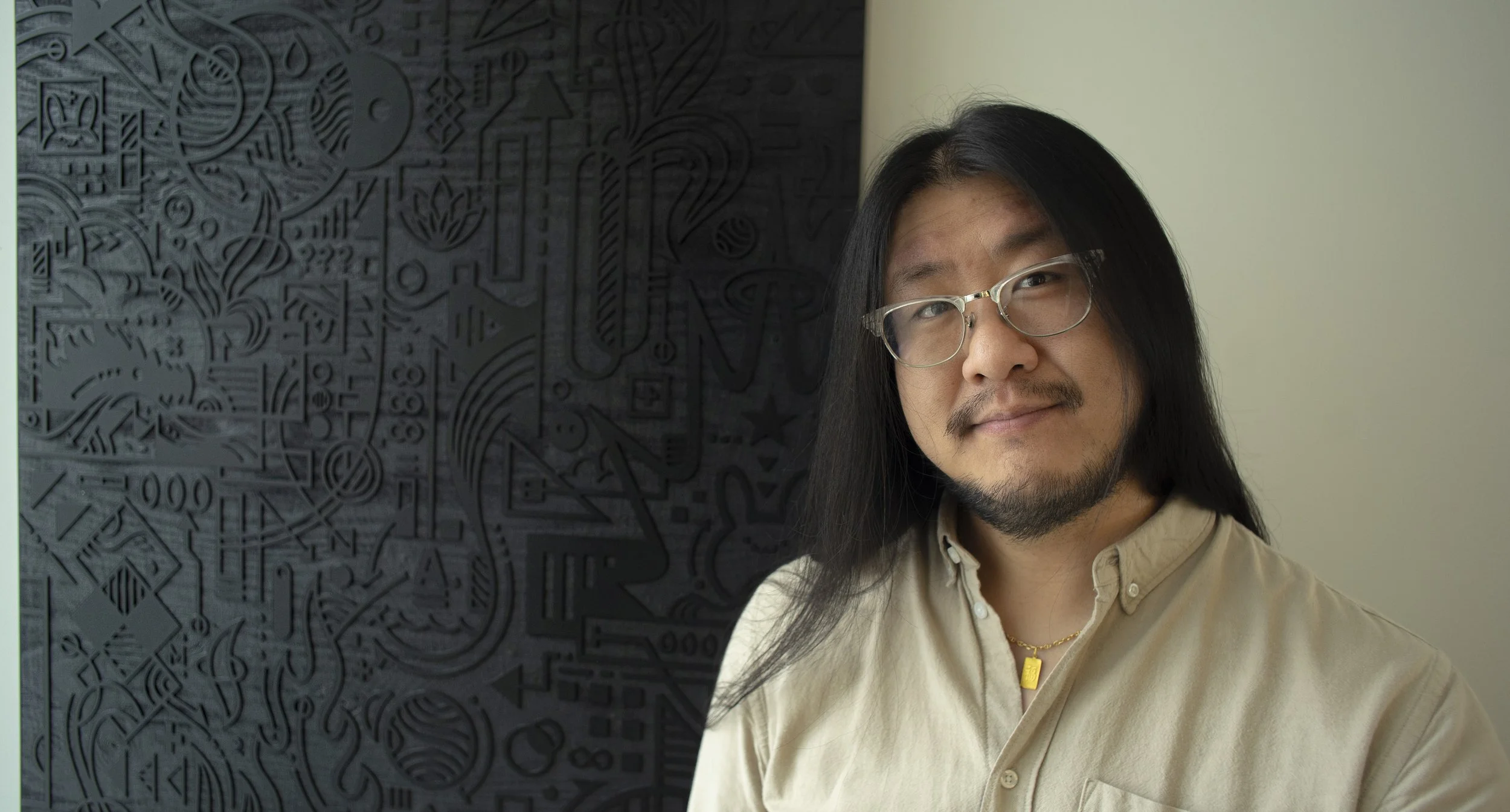
Jordan Wong | Everything x Nothing (2024) | laser-engraved wood panel with black stained finish and powder-coated steel frame
photo courtesy of Cornelius Martin of Wick Monet
Who is WONGFACE?
Jordan Wong is a second-generation born Chinese American and Pittsburgh native living in Cleveland. Wong has been drawing since he was 4-years old, inspired by anime, manga, video games and Transformers. As a child, he noted his difference among his peers and felt separate; escaping into art allowed him to create a world where he belonged and could thrive. He went inside.
At California University of Pennsylvania, he focused on refining his art through graphic design. After two years of unemployment following graduation, Wong began working for himself supporting local businesses, non-profits, and other solo entrepreneurs in Cleveland with logos and identities. He began showing his personal art and illustrations in coffee shops, which garnered him exposure and generated interest. For the past three years, Wong has shifted his time and energy toward his fine art practice and collaborative projects where he assists as design consultant or art director. Wong attributes his success to the relationships he has cultivated in his creative profession.
Play is Infinite
Play is Infinite is a collection of eight works displayed on various mediums highlighting processes to teach kids about building an art practice. Drawing inspiration from his cultural heritage alongside modern influences, Wong bridges the gap between digital and physical artistry; themes of creativity, empowerment, and personal growth are expressed in his own code. “I resonated with anime characters [as a child]; their stories and the journey to leveling up. I grew up in a neighborhood where no one looked like me, there were no Asian kids. I struggled to find belonging and identity. I connected with the heroes’ feelings of inadequacy, doubt, and insecurity. Witnessing their character development and subsequent transformation taught me about expressing empowerment.”

Xiao Huo Miao II (2024) | photo courtesy of Cornelius Martin of Wick Monet
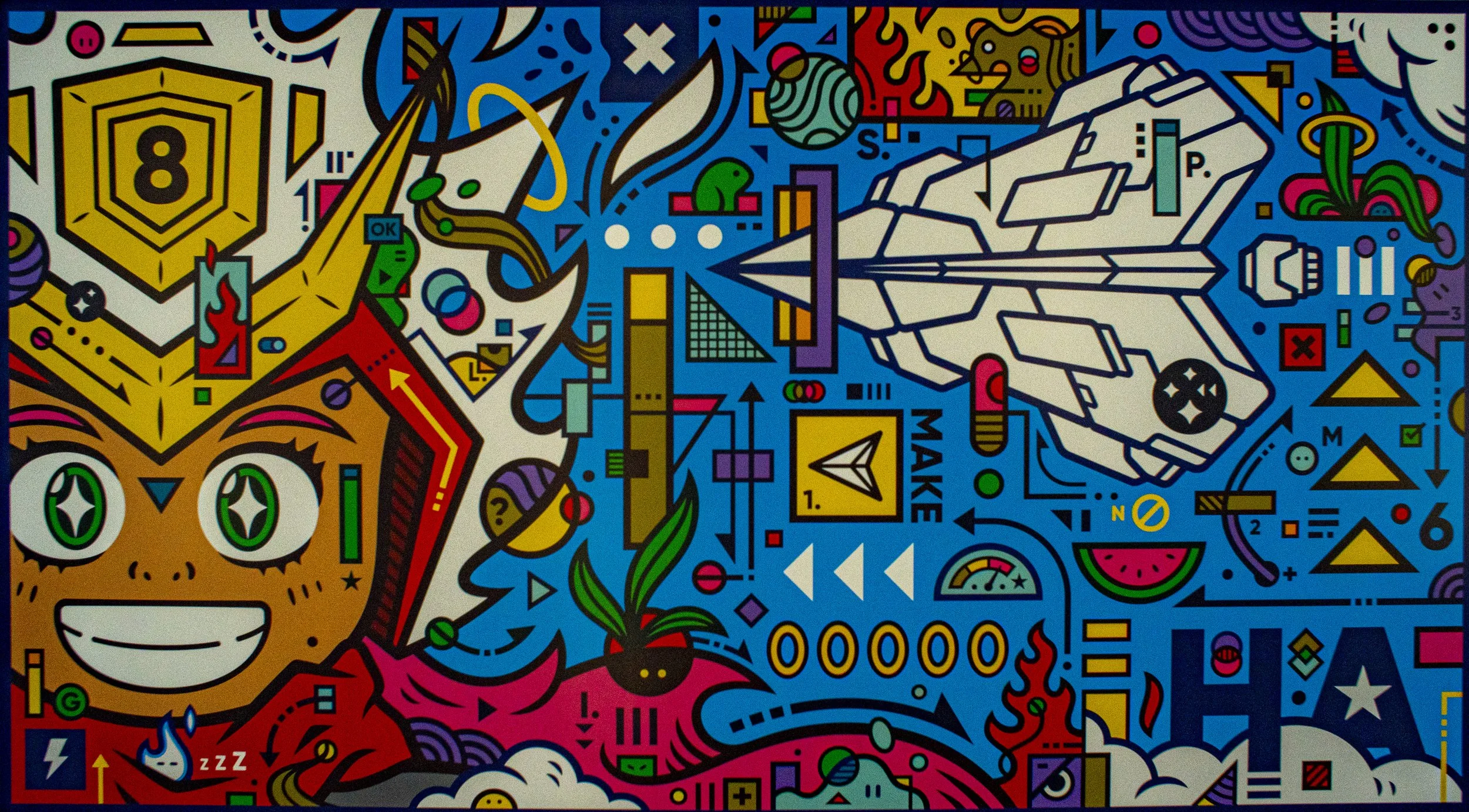
Xiao Huo Miao II (2024) is a lightbox of vibrant color inspired by Asian food packaging, which often includes mascots—a blue flame with a face against a pink background advertises antagonistic elements and gameplay iconography. The B with an arrow pointing backward means, if you hit B, you go back; and health bars identify your energy level. The mascot represents the spark of creativity, the things we face as an artist when trying to come up with ideas, while connecting with the energy of flow.

Tao (2023) | photo courtesy of Cornelius Martin of Wick Monet
Tao (2023) is an industrial print on DIBOND, white elements against a black background, paying reverence to Wong’s Chinese—specifically Toisanese—heritage. Many of the first Chinese immigrants came to America to build better lives for themselves and their loved ones. The railroad track motif pays homage to Wong’s ancestors, whose sacrifices paved the way for him as their descendant. The characters are the code: 韌 represents “tenacity,” and the other three, 破極限, translate to “break through limits”.
The collectivism mindset in Chinese culture expresses gratitude in sacrificial living for future generations, and Jordan is mindful of his blessing. “Living as a full-time artist means I come from ancestors who persisted and persevered.” He takes his work seriously, while having fun. “It's a game of chess for me, creating these drawings and orchestrating all the elements. So I establish rules for myself—subtle representations of philosophies I'm playing with in my head.”
Gamifying Life: The Hero’s Journey
Relating to Wong is easy; I notice there exists between us no difference as we interact—we are autonomous, and the same. The philosophies he plays with, I also stretch and pull with imagination. Visual language assists Wong in his quest for identity; mantras hum mysteriously inside each work, offering subtle clues to his progress.
Is the Ultimate Self a destination, or a journey? Is it in your mind?
“That's the question,” Jordan poses, “Initially, it feels like a destination, and then it turns into a journey.”
Play is Infinite returns us to our most inherent desires—those developed innocently, in childhood. Who I dreamt of growing up to be is possible to achieve. I lean heavily on symbolism in my own work, which is centered on self-discovery and expressing a higher, or “healed”, self. There are many factors shaping what we believe about ourselves, and through art as therapeutic practice, I’ve grown more interested in what I believe about myself and expressing that self through my work. So it is easy for me to get lost in Wong’s world, because I find my Ultimate Self reflected.
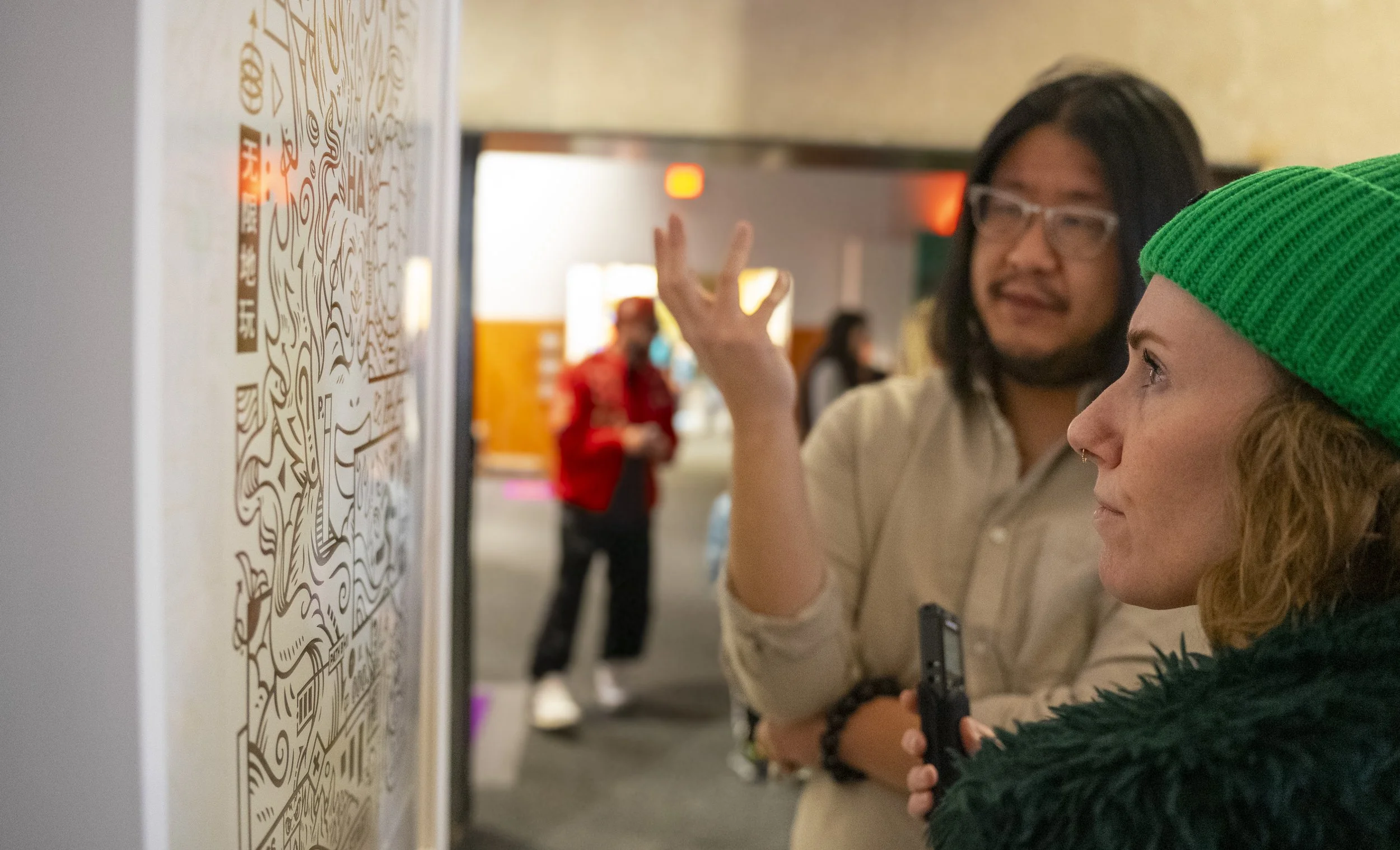
BOOM x BLOOM (2024) | Gold-foil embossed print with laser-engraved mat | photo courtesy of Cornelius Martin of Wick Monet
Creativity is an empowered state.
PLAY x FLOW (2024) is another personification of creativity from an anxious place and the franticness of having these ideas within you wanting to express. Wong used blue pencil to represent the I-gotta-get-it-out feeling—the hurried nature behind capturing an idea and birthing it.
Creativity is innate to being human. We envision things that don’t exist and bring them into existence. Wong and I each believe our natural state of being is the creative flow—of ideas, inspirations, thoughts, contemplations and emotions. Boredom is ripe for imagination and mistakes are lessons; keys in mastering one’s artistry and becoming. The process of creation, with its inherent imperfections, is essential to finding authenticity and connecting with one's true self.
“An empowered artist is someone who manifests anything that's,” Jordan taps his skull, “up in here. We have the freedom to create. The second quality of an empowered artist is being able to share it; to take all the stuff that's inside you and expose it to empower others with delight and inspiration.”
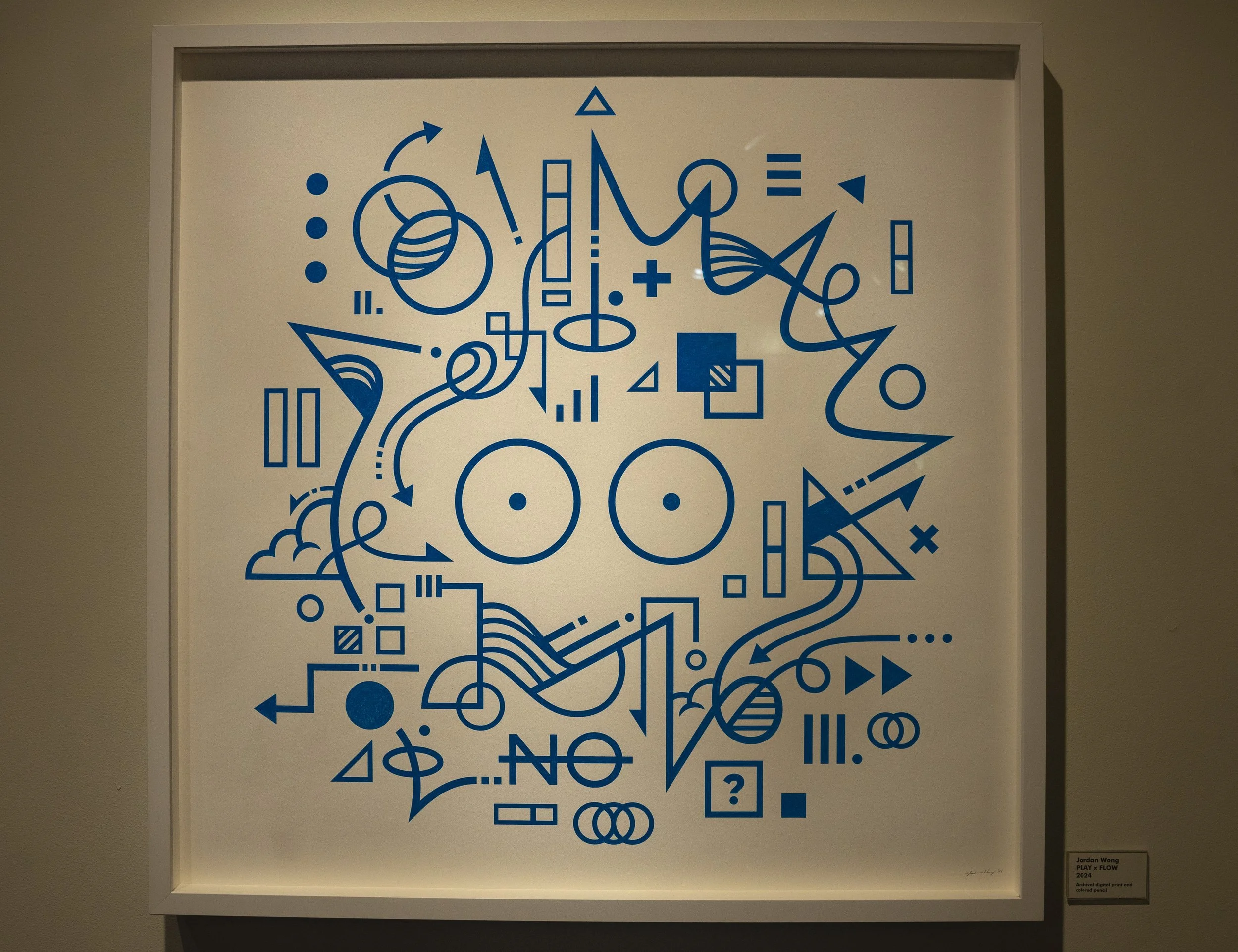
PLAY x FLOW (2024) | photo courtesy of Cornelius Martin of Wick Monet
Mastery Requires Practice & Discipline
Wong’s follow up exhibition is PRACTICE+-, a collection of 23 works on display at The Portal (February - April 2025), inviting us to ask the question: What am I practicing with the words I use and the thoughts I entertain? To achieve mastery of the self, one must practice being the self.
I studied each piece in PRACTICE+-, making notes of the repeating icons (the animals: rabbit, fish, hawk, turtle, and tiger), and began transcribing his code; the hints of how Wong achieves mastery.
oki doki
Hi!
PRESS START BOSS
LESS◼N UH? SURE OMW
UP x OUT
CLASSIC NICE PAL
BELONG
BEGIN AGAIN
WON ONE
SLOW STAR
YEAH GET UP HEY PLAY
be NOW
DREAM UP MY HOME
SOFT OPEN A+
FLOW BURST RAD LIFE GOOD TALE FINAL
LET’S PARTY THERE HERE AWAY
YES I DO!
THINK ONCE MORE
EVERYTHING X NOTHING
AND YET…
TAO HA HA OH WOW
IT IS HAPPENING!!!
WOUNDS ▶ WISDOM
TOO MANY? CONTINUE
KO OVER
MAX PWR
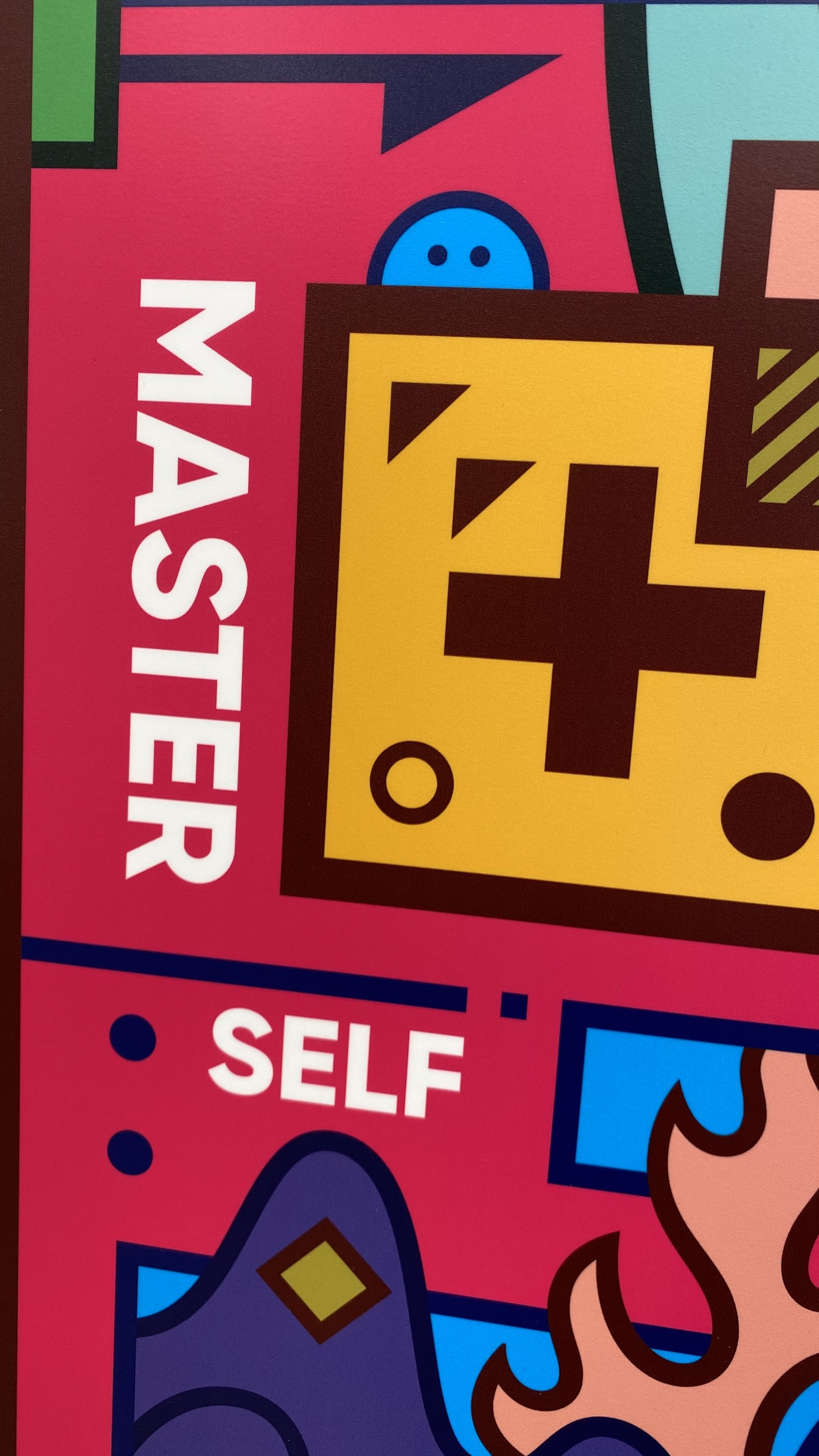
MASTER SELF
END
The Sun Series was my favorite; 12 limited edition screen prints of organized chaos with hidden meaning. I decided to play with Wong’s code and counted out to the ninth piece, from left to right, treating it like a tarot card.
I am AS WITHIN
OUTSIDE 50%
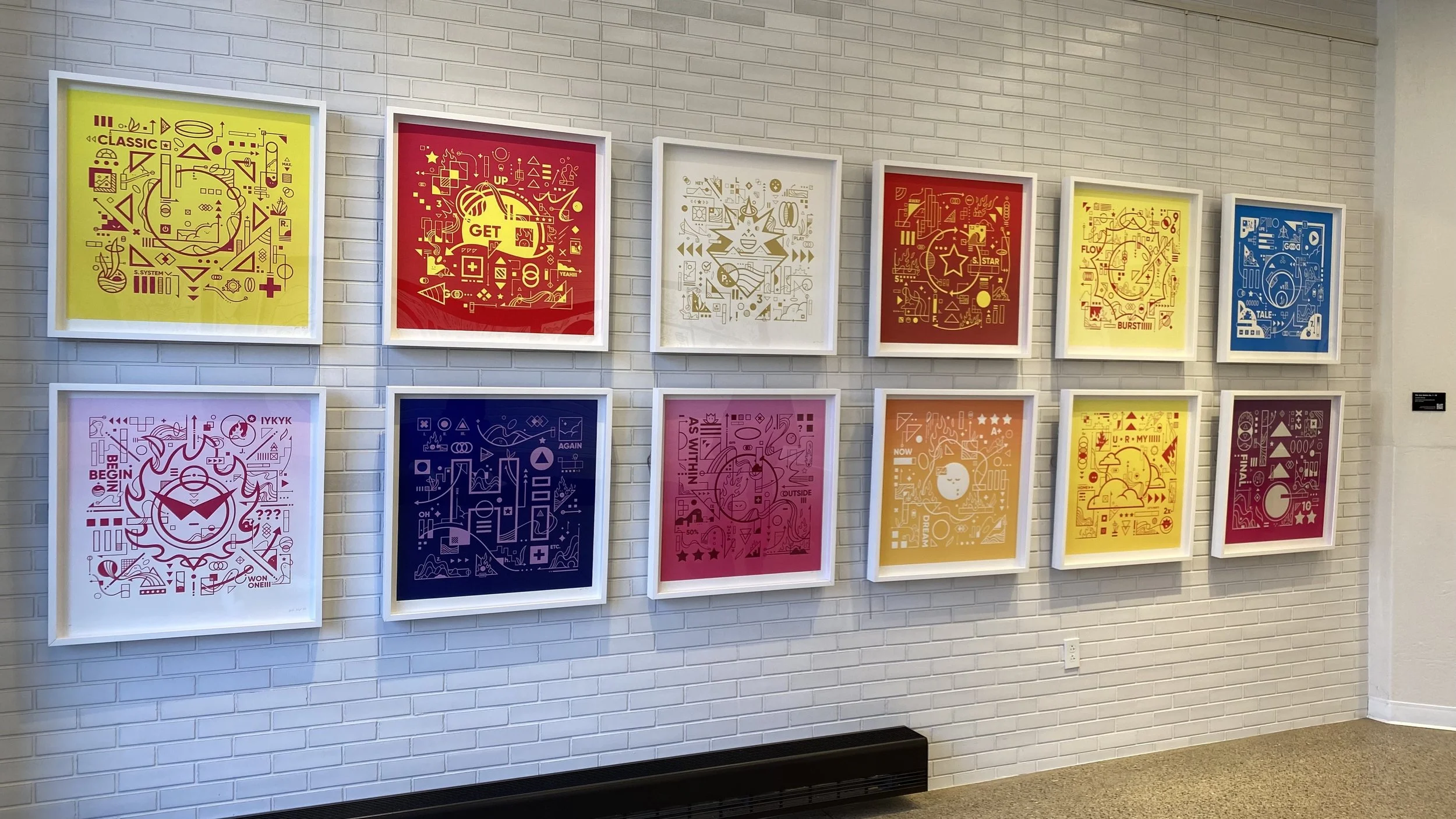
The Sun Series
Xiao Huo Miao II (2025) returns in this collection as a holographic piece, revealing creativity is always there inside of us. Sometimes you have to change positions, look from another angle, to see it. When you look, it may seem new, and it may also feel familiar. The Ultimate Self works like that.
Wong is forthcoming about the time it’s taken him to embrace his Ultimate Self, it doesn’t happen overnight, and I can commiserate the task of changing and growing into a new identity as I believe it of myself. SLOW is in my personal code, too.
“It took time to be comfortable with the identity of being an artist, and embrace my sense of self,” Jordan shares, “It was more than 30 years before I could look in the mirror and be really proud of the person looking back. The confidence was built in the freedom to express—to be myself, both in my art and daily interactions, conversations, everything. There's discipline required, and so much practice that has to be done.”

The Sun Series No. 9
Being Ultimate Begins Inside
The Ultimate Self begins as a fantasy version of oneself—all powerful, capable of anything, magnetic and beautiful. Creating this self is a way to combat feelings of insecurity or the struggle to find belonging. “The version of me standing here is my younger self realizing I can do this. That’s the first level,” Wong explains. “Then it's discovering why you want to do it, and who can you do it with? Who can you do it for? As I've gotten older, the Ultimate Self is a more contemplative idea. I’m exploring all the questions, what is it? Does it follow you? Is it something you attain?”
Achieving the Ultimate Self is connected to a sense of ego death, liberation from external influences, and a focus on inner wholeness. There is no step-by-step process, no prescribed method for achieving the Ultimate Self. It is a multifaceted, evolving journey; a culmination of lived experiences intertwined with artistic practice and self-discovery converging into a unified whole. This can manifest as an intense moment of clarity, an epiphany. The Ultimate Self is not a fixed state but rather a fluctuating one, with periods of connection and disconnection. The journey, including moments outside of this Ultimate Self, is part of its development.
I can see Wong’s code inside his work because I have my own. I learned to achieve the Ultimate Self when I recognized it's not as much about becoming myself, as it is being myself.
Wong’s beaming face tells me I struck a chord; this is why I felt I knew him at first meeting. “Most understand this in theory but not in practice,” he agrees, “When you come to this realization and you practice, you learn to focus your energy inside and that affects your external experience. It’s not the other way around. A lot of the time we point the finger, judging a situation, person or interaction instead of going inward to calibrate ourselves. It's really our perception of those things, and how we react or respond to them that shapes reality and the worldview we craft. The external doesn't matter; or it matters less and less—a hard pill to swallow.”

So You Wanna Transcend, Huh? (2024) zoomed-in
So You Wanna Transcend, Huh? (2024) zoomed-in | industrial print on vinyl installed on aluminum panels
Like Wong, my quest has been decades in the making, and Memoirtistry is the method I developed to aid me. To be the Ultimate Self, I’ve had to make peace with, and sometimes sacrifice, the parts of me who do not believe in me so I can change into someone I’ve never been. In Taoism, there is a belief of effortless effort—striving for something while also not having it simultaneously be a practice of lack. “This is where it gets paradoxical,” Wong explains, “In the pursuit to become the Ultimate Self, you begin with the idea you are not the Ultimate Self, which is not within the definition of being the Ultimate Self. So it's turning in on itself. Recontextualizing it, in what ways am I preventing myself from being me? Because at the end of the day, you can't be someone else. You have to be you.”
He adds a caveat. “It’s very scary to grab what you want.”
Wong emphasizes the importance of self-reflection, emotional awareness, and addressing inner anxieties as crucial steps. This involves acknowledging and processing difficult emotions, such as those stemming from trauma or feelings of inadequacy. Practice doesn’t equal perfection, it becomes play and anything goes, infinitely. When I am present with my Ultimate Self, I feel good being myself; I don't want to live in my head. I want to engage with the world and consciously respond.
Wong’s art expresses the strength that comes from believing in the self. “It's a powerful thought exercise to envision yourself as the Ultimate Self. How do they act? What are they prioritizing? What are their habits? When you start implementing what you learn, you realize the Ultimate Self is me. It's me right now already.”
Play & Practice are a guidebook to the Ultimate Self.
Wong encourages infinite play and ongoing practice to be the Ultimate Self. It’s a cycle of growth that allows you to be the most you you can be. When Wong first greeted me at The Children’s Museum, his Ultimate Self met mine; the ease in creative conversation, asking questions and wondering, we were artists in tune.

Dreamland (2024) | vinyl print | photo courtesy of Cornelius Martin of Wick Monet
inside of WONGFACE, I see myself reflected,
and because I see
I can be
more me
simply because he
is being
We are the only ones who can fully realize ourselves. This pursuit can involve rebelling against societal expectations and instead, embracing vulnerability. Authenticity and sincerity have strong energetic resonance. “Anything outside of that,” Wong explains, “if there's not an organic flow or vibrance to it, is contrived, fake. It's forced. Something with high energetic qualities is also that which is the most comfortable and accepting and true. The Ultimate Self is your truest self.”