

The Artist’s Battle

Pittsburgh Artist CARO
“I really had to kill my ego this year.” Pittsburgh Artist CARO sat across from me, sipping iced coffee from a straw.
We met at Big Dog Coffee in Southside to introduce ourselves in mid-December, two months after she competed in the Pittsburgh Art Battle and won.
“How do you kill your ego?” I asked.
The first time I saw CARO—short for Caroline—she was a returning competitor to the local Art Battle hosted at Athithi Studios in Sharpsburg.
On September 12, 2024, the energy was high; the gallery buzzed from a cocktail of anxiety and anticipation. Some were invigorated by the stimuli; a DJ spun, a food truck fed, and artists prepped to paint against the clock. Attendees vote for the winner of each round and can bid on the pieces at the end of the night. Works created are silent-auctioned with 50% of the proceeds going to the artists. Despite the event being a competition, there was a noticeable sense of camaraderie.
Sensitive to the noise, and without company in tow, I wore earplugs and focused on keeping to myself while noting observations about the experience. If I wasn’t being an art journalist, I might’ve left; it was too stimulating for me, but I was there with a goal in mind: find an artist who inspires you. As the first of three 20-minute rounds began, the music and voices increased in volume. A steady stream of onlookers orbited the artists who painted in circular battle, preparing to cast their votes.
I zeroed in on one of the pieces. A being with a long neck attached to a head with a face expressing intense emotion; a frowning mouth and a single bloody tear leaking from one eye. The background filled in with a deep blue. Feelings of anger, sadness and confusion surfaced; I was reminded of the intensity and scale of these emotions. I was moved by the current of the brushstrokes. I could see myself inside the painting the way I see myself in my own paintings. I paused at the artist’s easel and gave all of my attention to CARO.
The War is Over, 2024
To give an artist’s work attention in a gallery is one thing, to give the artist herself attention is another; to witness the artist in the act of creation however, is an incredible privilege. I find, when attention is paid to my work, it impacts my growth as an artist as much as it can impact the admirer. Now, sitting across from her in a cafe, CARO fills in the picture. She describes her approach to painting as intuitive; she looks at the canvas, “blacks out” and then “this” happens. The pieces [for Art Battle] are unplanned besides the color palette. We are similar in our approach; giving way to creative flow, moving without forethought and trusting the process, is a healing practice I employ within Memoirtistry. The portraits CARO paints are all versions of herself—another similarity; everything I paint are versions of myself.
“You have to feel it at that moment,” Caroline speaks of the intuitive process while I nod along in agreement. “You have no idea the impressions your own work has on you until you’re done making it.”
Art Battle creates a vibrant environment; as a competing artist, you are not only competing with other artists, you are also in a fight with yourself to stay focused and manage personal anxieties over being observed. I tried to imagine myself competing; painting two works, each in 20 minutes to a point of completion, enduring the pressure to produce. The first portrait she painted, in round one, The War is Over, offered CARO’s point-of-view—a hint of what she was going through, right then, as we all watched.
I wondered then what other battles Caroline has been fighting.
CARO has been an artist since she was a child, but there was a time she stopped painting due to mental health confrontations. “Awareness of an ‘issue’ can take over your whole life,” she confessed.
In 2018, after a routine check with her doctor to discuss her growing anxiety, she was diagnosed with stage two thyroid cancer. I asked her what it felt like, existing inside a body with cancer. “It’s so cliché [to say], but I could feel a dark being inside of me. I have always been sensitive to my body; I wasn’t myself for the longest time.”
In January 2023, she received the news she was cancer free. The isolation required to heal overlapped with the isolation of Covid-19, and boredom guided her back to the easel. In her return to art, she painted a portrait of her brother’s dog to give him as a gift. Soon after, she began receiving commissions and was painting more regularly. But her style adapted as her focus in life shifted to healing from trauma and the main subject of her work soon became herself.
The second self-portrait CARO painted for the Art Battle holds a clue pointing to her progress. A rich red background of flames highlights a face framed by straight purple hair with wide, tired eyes and long lashes hanging heavy on the lids. This battle has exhausted the artist, and yet, the mouth is turned in a smirk. Caroline tells me she had a feeling she was going to win and her confidence is evident in the painting. The audience watched her battle herself and rewarded her in her efforts; she was voted champion and I wasn’t surprised.
To kill your ego, she says one must “become overly self-aware; like yourself a little bit.” In the act of liking yourself, the ego can inflate. The caveat is to like yourself while also recognizing there are things you don’t like. Accepting what she doesn’t like about herself is the battle CARO fights now. “I was aware I had flaws, but I spent so long trying to survive other things that I was just kind of ignorant of the negative parts of me.”
In February 2025, she released photographic portraits featuring a clothing collection made for a series called I FORGOT (HOW) TO HAVE FUN where she explores polarity and the duality of existence; extremes expressed in sharp black and white exposure. One portrait represents the grief she feels around who she might have been; a relatable theme for anyone honest enough to admit. Self-reflection, when acted upon, can transform you into a person unrecognizable to those who knew you when. This shift in external perception can cause an upset to your self-image; others may not believe you have changed and the denial of a changed you can impact future growth. The temptation to remain the same for others is great.
CARO continues to heal the need to please by loosening up her art process. “A lot of my paintings are old paintings, covered. I like the texture it adds.”
The texture of scars from what once was is evidence of the process of acceptance.
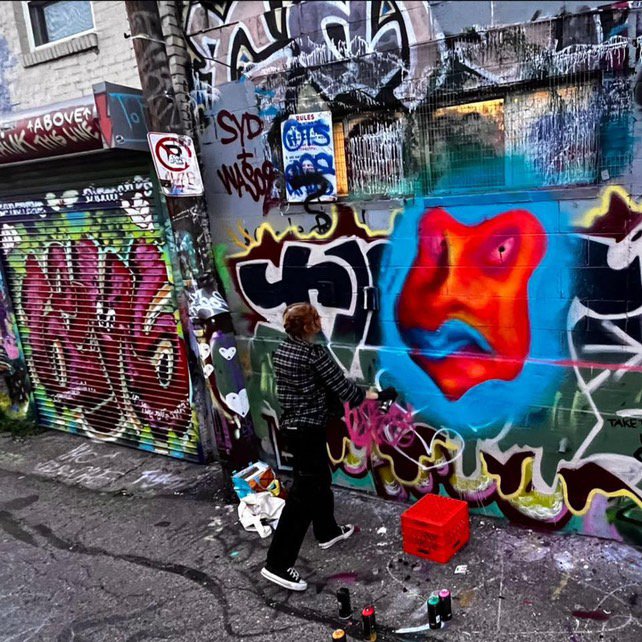
CARO at work
As Caroline returns to battle in the new year, her combative technique, to fight with artistic expression in front of an audience, inspires me in my own practice. Her work illustrates a profound truth: art is inherently personal and universal, intertwining her internal experiences with collective themes of identity, trauma, healing, and joy. In every self-portrait, we see CARO’s resilience and are invited to explore our own emotional landscape alongside hers. Killing the ego doesn’t actually require death but acceptance. When we see what is, what is is free to change.

Betty Davis, The Independent Artist & Crow
As a transplant from Washington, it’s been difficult to create meaningful connections in Pennsylvania. I’ve moved 29 times across six states and cannot relate to the many generations who’ve stayed in Pittsburgh, never to leave or left only to return. I have a restless spirit and, when tended to, it grants me unlimited access to creative flow. I am a transitory artist, however, I am not immune to homesickness; familiarity tethers me to the present. Without an anchor, it’s easy to feel lost. I seek the wonder and captivity of solitude, the healing mediums of the arts, and the kind of attention only the dead can provide; I commune with grief, a constant companion and muse.
When I learned Betty Davis is buried in Homestead Cemetery, within walking distance from where I live, I was struck by the news of her death; I didn’t realize she passed away in 2022. I discovered her music and Nasty Gal persona in early 2021, when I stumbled upon the documentary They Say I’m Different (2017).
Betty was the first black woman to write, perform, and manage herself. She was described as an enigma; her clothes expressed who she was—an extreme funkstress of jazz fusion—and like most musicians of her caliber, she influenced many. She was “Madonna before Madonna” and “Prince before Prince”, but I had never heard of Betty and wondered why. The rawness of her vocals and in-your-face expression on stage, how she owned her body and moved freely, entranced me. Uninhibited by drugs and alcohol, or by being a black woman, Betty was liberated. Her performances shocked audiences; at the time, there were no other women doing what she was doing. Betty described her music as raw, saying that “anything raw has to be pure.”
Raw is the purest form of innocence.
Betty’s growling voice spoke to the rage in my belly–ancient and sacred, an eternal flame. I wonder, if I don’t speak about it, does it make it unreal? If I don’t speak about it, it doesn’t go away. This woman did what I aim to do in my work; reclaim my innocence by releasing trauma through self-expression in performance and artistry.
Betty’s arrival on the ‘70s music scene was short-lived; she was banned, boycotted, and soon, she disappeared. Her abrupt departure warranted her an “almost mythological reputation for being reclusive.” The decision to step away from the music industry when pressured to conform, mirrors my own struggle against a society that prizes marketability over vulnerability. Her bandmates say she was fed up. She suffered in her liberation; being “ahead of the times” is a heavy weight. Artists are often pushed to change the very thing that makes us stand out; to dilute our voices for commercial gain, reproduce our work for easy consumption, and operate outside of our morals for fame, fans and followers. Disingenuous markers of success.The artists who stand out to me are those who don’t give in—the ones who’ll die to their vision before selling their soul, maintaining independence while navigating the pain of freedom.
Whenever I leave the house, I step into the world as an artist. No one who asks me what I do is surprised when I say I am an artist. It’s when I’m asked “what kind of art” that shifts the conversation. The struggle is being listened to and understood. I can tell when I’m not; I am interrupted and receive unsolicited advice—told what I “should” be doing more of (marketing/social media) and what I “should” make and sell (to become successful). When I comment these things I “should” be doing directly oppose my personal values, my work is dismissed as a hobby. As if what I do have to offer is not enough.
Throughout the film, Betty makes symbolic references to Crow, which signifies the beginning of her self-awareness that she was different. Crow is the heartbeat, she says, and to me it signifies someone under the influence of creative flow. Since she was a girl, Betty felt there was “something inside of her that had to come out”—a similar restlessness to my own. It was the women who sang the blues that connected her more deeply to Crow. “Women who sang about how they felt inside … about things that weren’t right.” Her grandmother’s wise words rang out like an alarm. “You should always know who you are and do what you have to do.” (That’s a “should” I can stand behind; the integrity to rise above, no matter what.) Betty didn’t speak from oppression, she sang knowing who she was and what she deserved.
“In the end,” Betty concluded, “I found I could only be myself. Being different is everything; it is the way forward.”
She inspired me to embrace my journey of self-discovery with boldness, which is why I’m living in PA in the first place. In May 2023, I accepted an invitation to study performance with an artist in Georgia. I was ready to develop Crow for the stage. I moved to Atlanta, but circumstances changed and my study was disrupted; no sooner had I arrived, I was on the road again, heading for Pittsburgh. Even as I wrestled with homesickness, I knew I couldn't return to WA, not yet. Where Crow beckons me to go, I follow.
Betty returned to Homestead after her father’s death and laid her music career to rest 44 years ago. Revisiting They Say I’m Different, the locations are familiar to me now. Listening to her albums while I drive these streets, the borough pulses with the energy of her legacy.
Rest in peace, Betty Davis.
The body that housed the soul of The Queen of Funk calls me to her gravesite.
Her resting place ignites a desire to ritualize my time here, however long it may be. Echoing her spirit of defiance and unapologetic self-expression, I release expectations of being understood. To honor Betty’s life, on the ninth of December, I placed the dying heads of nine cut pink roses at the headstone; I was born on a ninth, and she died on a ninth. Three nine’s divisible by three; a calculation and request to the gods of numerology.
A kinship with Betty continues to develop across time and space. Her return to Pittsburgh signals me to consider a return of my own, to my birthplace in Anchorage, Alaska. I trust Crow, my compass that tells me when to stay and when to go. When I visit Betty, I sense I belong here; wherever I am is home. I can never be where “I am” is not.
“People tell me I paved the way,” Betty reflects in the documentary. “I’m happy about that. I’m happy my music is still alive. For a while I flew high and strong, but the struggle to breakthrough hurt me. Everyone wanted me to be someone I wasn't.”
Being true to oneself can mean standing against the current, and some of us have the bravery to do so. Like Betty Davis, may I also refuse to compromise my creative vision. She chose independence, something difficult for artists, especially women, to have, and I choose it too.

Exploring Gnosis & Randonautica with T.H. Kainaros
Ecosystem, 2024; T.H. Kainaros
T.H. Kainaros and I share a belief in gnosis; we envelop ourselves in spiritual mystery.
He is pensive, poetic, subtle, and thoughtful. We met on Tinder when I arrived in Pittsburgh, seeking solace and distraction amid an emotional breakup and unexpected change in my life’s course. I was not supposed to be here, and I am exactly where I am meant to be. It is not easy making friends as an adult, and it is too easy to make temporary connections shrouded in romantic foibles and call it a relationship.
Avoiding disaster, Kainaros and I focused on our roles as artists. His body of work on Instagram moved me; inside his ethereal illustrations and intriguing animations, I gave way to the haunting of his spirit. His art told me more than his words in conversation had, as of yet, and I sensed a true kinship. We began a friendship grounded in creativity and vulnerability. Our individual artistic processes guide us to the blank page or screen or canvas without forethought, allowing intuition to guide color choice, brush size, layering effect, and hand motion. Trusting the rhythm of flow lends us easy access to explore gnosis. Self-discovery through art provides comfort. We are two introspective souls navigating a world we often feel out of touch with.
Kainaros introduced me to Randonautica, a “Create Your Own Adventure“ app. The objective of a Randonautica adventure is to notice what is brought to your attention and to engage the environment and yourself with curiosity. The app randomly generates coordinates that enable the user to explore their local area. According to its creators, the app is ‘an attractor of strange things’. It gained controversy after a report of two teenagers coincidentally finding a corpse—in West Seattle, where I used to live—while using the app.
Our adventure began at 61B Cafe.
I was excited to see Kainaros; my body can relax in his company which tells me this person is a friend. He listens and supports with gentle curiosity. He does not try to change me or provide unsolicited advice. I am accepted.
We caught up on our lives, discussing family, relationships, artistic dreams, and the ongoing struggle to carve out more time for what we love—placing creativity in a war against financial “success”. Kainaros shared his previous Randonautica experience as a model for understanding, and then he “spun” for directions three times (to avoid landing in someone’s backyard). A digital bird flapping its wings signaled our path was loading. Our destination was revealed: Frick Park.
It was natural for me to point out magical elements of our surroundings with Kainaros. We wove sacred narrative as we walked.
A sandwich board proclaimed, “Be yourself, not someone else.” A black limousine from another era adorned with alien green headlamp covers and a kayak on the roof. The word “funeral” came to mind. A voice inside causes me to wonder aloud if I might commune death in the water. Kainaros lets the comment float on the air.
We noted the juxtaposition of license plates—the 3333 beside the 4333.
Two little libraries at the corners of neighboring yards. The first contained treasures—works by Dorothy Parker, a poet, and Philip Pullman’s Daemon Voices, a book about the art of storytelling. I am assured that my own practice of Memoirtistry® is worth all the time I give it. The bird on the cover, a crow. We paused then, and I flipped randomly to page 189. “Great art has always had this double character, this ability to look at the world and to look at itself at the same time, and the greatest art is perhaps where we see the two things in perfect balance.”
The second library was uninviting, the titles heavy with religious undertones–live grenades–and so we continued along. We discussed a listening exercise I learned during a kayak tour to Sycamore Island led by artist Erin Mallea with Shiftworks. Participants were instructed to identify sounds to focus on, noticing thoughts, feelings and bodily sensations. I’d followed the sound of a siren that day, inducing grief. Revisiting the thought, I felt a sudden pang of homesickness for the trails I frequented in Washington. But here I was with Kainaros and I cherished the present. The birds chirped overhead signaling our arrival to Frick Park.
“I’m like a bird, I’ll only fly away,” I sang aloud. We laughed. Retreating into nature is a reprieve from digital noise. In this sanctuary, we began to discuss the weight of social media, the scarcity of genuine connection, and barriers that often confine artists. Kainaros and I agree it is a challenge being artists in a society addicted to distraction, in a system that doesn’t know what to do with us. On Instagram, I display what inspires me to stay the course when I want to give up, assuming no one wants to listen to what I have to say. Listen to yourself, a disembodied voice whispers.
A chipmunk with full cheeks darted across a fallen tree trunk. An acorn fell from above, and both Kainaros and I moved toward it. He reached it first. A second acorn dropped but I couldn’t ascertain which it was among the many, so I refocused on the chipmunk. I want to be drawn to what nourishes me, the voice admits. My instinct is intact.
“No one knows we’re doing something on purpose,” I remarked to Kainaros. “They don’t know they’re a clue to something.”
What appears random at first glance can reveal connections and insights that expose profound truths about ourselves.
When attention is paid, with intention and openness, it fosters understanding. This is a free activity, available all the time. As we wrapped this adventure, he escorted me to my car. Hugging him goodbye feels like touching a human who is dreaming—awake and sleeping, he is always one foot in the liminal realm.
Gnosis is a feminine Greek noun which means "knowledge" or "awareness." It is often used for personal knowledge compared with intellectual knowledge—those things you “just know”. In 2020, I was formally diagnosed with PTSD. The prefix “dia-“ means “complete”. Dia-gnosis is “complete knowledge”. I have the key. The concept of gnosis tells me the knowledge I seek to heal is accessible inside my own body. I can live free of anxiety and worry when I discern patterns of synchronicity and heed the omens nature offers.
I connected to a deeper sense of self with Kainaros that day; his peacefulness encourages me to be more of me, not live into some ideal anyone may project of me. There is no mask I must wear, no act I am required to perform; I can explore the shadows and light of my own consciousness and he is capable of bearing witness.

The Third Dream, 2024; T.H. Kainaros
As our days continued separately, we shared texts noting the symbols. Gnosis will not produce neatly packaged answers, but engaging in the ongoing process of discovery generates purpose in our lives. The act of engaging sincerely with the world—being present, observant, and open to the unexpected—gives rise to a deeper understanding of our existence. It is what artists do; and art supports life.
Presence is the ascension, and I am in heaven beside Kainaros.

The Eight-Year Impact of Pleiades
Pleiades floor plan at the Mattress Factory
The Observer Effect, first proposed by Werner Heisenberg, theorizes that the act of observation can alter the very existence of what is being examined. Pleiades, the permanent light installation by artist James Turrell, has resided at the Mattress Factory since 1983, and my engagement with it over the last eight years has changed my life.
In 2016, I visited Pittsburgh.
I lived in Washington state with my husband and I did not identify as an artist. When I arrived at the Mattress Factory, Pleiades—a reservation-based experience in darkness—sparked my curiosity. Asking no questions, I signed up, intrigued by the mystery.
Walking the concrete ramp toward Pleiades, the darkness engulfed me. I took my seat, eager. My eyes strained to adjust to the pitch black. I felt, before I saw, a soft pulse of energy—light—coming forward from behind me. Though my body remained still, it was as if I was moving within a force field. I was compelled to keep my eyes open for fear of missing out.
As the pulsing ceased, a deep purple thread emerged, thin and striking, before coalescing into an orb. Tears stung my eyes from the effort of trying to see. When I blinked, the orb danced, sentient and aware of my presence. Just when I thought I could grasp it clearly, it darted away, leaving a temporary imprint on my field of vision. The orb was alive, and I felt a profound kinship—a tug deep inside my chest. But 15 minutes was not enough time to fully grasp the orb’s true nature.
During the same visit in 2016, I participated in a guided meditation—intending to meet my future self—with a small group of strangers via Zoom. Our guide led us to enter a room in our minds and in this conceptual space, I found myself standing inside a white room with no windows and no doors. Meeting my future self within this room foreshadowed an impending transformation in my life, but I could not imagine what it might be.
When I returned to Washington, the purple orb from Pleiades haunted my dreams; it would appear behind my eyelids as I drifted into sleep. I would try to catch it, but never succeeded.
The Observer Effect resonates with me now. Pleiades altered my being, and I, in turn, altered Pleiades by removing the purple orb from it.
Fast-forward eight years, it is 2024.
I am now a resident of Pittsburgh, I am divorced, and I identify as an artist. I am not who I was in 2016, and I am grateful. I re-entered Pleiades with anticipation of the orb, but I sought new understanding grounded in familiarity.
I used earplugs to minimize surrounding noise; to hear myself better. A persistent bright light to my left vanished when I turned toward it, and the room became a consuming mouth. I welcomed being swallowed whole. A soft, dusty rose hue permeated my vision; I questioned if it was a product of my expectations as I did not see this color the first time.
Then, the deep purple lightning struck to my right, reactivating the mystical force field. I awaited the orb’s appearance. The dusty glow never dissipated; it grew and shrunk with intensity and at its strongest, emitted a brilliant white center. I sensed another presence then and all color washed out. Was the light scared? I became vulnerable. Desiring aloneness, I opened my eyes wider, concentrating on the void. The orb briefly appeared, as if to say hello, before being absorbed into the disappearing pink haze. I confronted echoes of trauma and fear, recalling various states of feeling lost but later, the joy of being found. Gazing into Pleiades' emptiness, I summoned the elusive orb, but it did not return.
A wave of urgency about time overcame me, and I heard my own voice speak from the center of my chest. My heart whispered secrets. Time is created and I own it, and I can be here as long as I want to be, so relax, take my time as we say, so I did and I was with myself for a million years. I realized I could stay in this moment indefinitely so I relaxed, embracing an eternity within the solitude.
The Artist & The White Room
I hadn’t investigated James Turrell prior to my visits, focusing instead on defining my encounter. However, after my second visit, I learned that he began exploring light in 1966, transforming hotel rooms into pure white spaces with no windows. He blocked external light and concentrated on projected illumination.
These white rooms bear a striking resemblance to the mental environment I created during my meditation of 2016. I do not know, nor can I prove, whether I met my future self before or after my first visit to Pleiades. However, the parallel between Turrell’s artistic method and my visualization suggests deeper connections. I am that future self now; I am the projected light within my own life—my own white room—navigating the darkness to uncover the spectrum of my existence.
This revelation serves as a metaphor highlighting how our experiences shape our beliefs. We have the power to transform our surroundings through observation, introspection and purposeful interaction. This is central to my artistic practice; creativity can only flourish when I am brave and traverse the inner landscape.
Memoirtistry® is a mirror to Turrell’s exploration of light. Both our works serve as catalysts for self-discovery. Healing begins within, and Pleiades invited me to address and redefine my relationship with the past; it ignited a deep reckoning with my identity. Why am I so afraid to heal? Because I have been afraid of myself—of using my own compass.
Pleiades triggered me to fall in love with my light. The installation compels each observer to face their darkness, fears, and unresolved narratives. The orb I first encountered in 2016 symbolizes more than mere fascination; the orb was me, projected outside of myself. I brought it in, which is why it followed me out.
Light and darkness coexist inside each of us, and Pleiades affirms the transformative power of art. I recognize now my capacity for growth and renewal. My relationship with Pleiades, much like my artistic practice, is an ongoing dialogue. With Memoirtistry®, I reclaim my power, paint my white rooms in whatever colors I choose while illuminating the path toward healing, creative expression, and the embodiment of my true selves. Being present holds the remedy for discomfort. Fear tells me I’m doing the work, but it is no longer running the show.
As Turrell encouraged me, so I encourage others—embrace your darkness and you’ll discover the light within. Pleiades challenges us to witness our evolving selves, recognize the power of observation, and become active participants in shaping our stories. Through this lens, the Observer Effect becomes a symbiotic relationship—art influences the observer and the observer influences the art, creating a dynamic interplay.
What will you see when you look into the void of Pleiades? And who will you be on the other side?

A 10-Minute Slow Look at Andy Warhol
Self-Portrait, 1978, Acrylic and silkscreen ink on linen // 1988.1.806
Displayed on the 5th Floor of The Warhol in Pittsburgh, PA, on September 7, 2024.
The Art Commentary Program at Wick Monet, owned and operated by Cornelius Martin—a person for whom the artist herself is of great importance, not measured by the money to be made from the artist’s work—has changed the way I approach art and it has dramatically shifted my writing. Memoirtistry is undergoing another transformation because the experience has created new goals; being an artist, who is also an author and certified editor, practicing the art of writing art commentary has reinvigorated my natural curiosities. In the commentary, I am free to express my artistry and my love of the craft. To say I am obsessed is to say enough. I have even gone so far as to pull my own paintings from my website with a plan to reintroduce the pieces through art commentary—adding by subtracting, another layer to the investigation of Self, as artist by artist through artist.
The cohort meets once a month (for six months) to offer peer reviews of each other’s work and to engage training. Last month, we met at The Warhol Museum. After touring each floor and receiving a wealth of insight from artist and program instructor Heather Hershberger—an ardent fan of Andy’s since childhood, influenced by her mother’s love of Warhol—we were given our assignment: a 10-minute slow look at any piece, followed by an additional 10 minutes to write a commentary. We were instructed to focus on describing not only our experience but the actual work, naming the colors, shapes, form and composition in our pieces, and we were allowed to take notes.
I departed the group from the lobby and, taking the stairs in twos, ascended to the fifth floor where one of Andy’s self-portraits using his screen printing method waited for me. I set my iPad in front of the piece and saw down on the concrete, legs crossed. And I looked slowly.
I see you Andy Warhol.
Andy Warhol’s self-portrait draws me into the person behind the art—the man behind the curtain; a wizard of his own Oz. His iconic white hair is screened black; his head is layered—three faces with six eyes. The pastels of blue, green, yellow and a pink that blends into nude bring easter eggs to mind. Yellow feels an afterthought, with pink heavy on the brain. The blue hues and green—water. I drown in Andy.
There are three Andy’s to consider: one looking at, depicting a brief moment of connection, one looking away, a distant dreamer, and one looking down, focused in thought… or is he ashamed?
The paint strokes are hurried; he didn’t wait for the paint to dry before applying more.
My two eyes focus on his nose; bulbous. I am moved to feel my own nose on my face, my index finger and thumb pinching the tip and then hugging to assess the curvature. The drips in pink around Andy’s most prominent nose, phallic. I cannot help but envision the many penises Andy has no doubt had thrust in his face, up against that nose.
I move to the mouths of the looking at and looking away Andy’s—they cut across the penis nose like an open wound. He bleeds in pastels.
i feel alone
the way i usually feel—chronic
in nature
but happy alone
…
easter inspires happiness in death
resolute ending
only the essence of the artist remains
a third eye activates—
i see you, looking at
i’m somewhere else, looking away
inside myself, looking down
I determine the portrait of the three Andy’s are unconcerned with shame, he is zoned out, calculating, in a flow state that cannot be interrupted by observation—an artist, in process.

The Bloodmire Empire of Chiina
Poetress & Author Chiina Bloodmire at Poetry Lounge
Chiina Bloodmire, a petite human with the auric energy of a powerful giant, walked into Big Dog Coffee in Southside and joined me at the table in the front window. Our eyes met, and smiles reflected. “It’s Chiina with two i’s, the better to see you with, and Bloodmire, like vampire, a hybrid witch.”
We eased into conversation, relating with vignettes of our daily lives. I became aware of Chiina through Millvale’s Poetry Lounge owner and independent publisher, Sean Enright. She and I were highlighted in an Instagram post advertising our upcoming book releases.
Bloodmire didn’t consider herself a poet until December 2023, even though she’s been writing poetry for over 15 years. “It was in October [2023] that I lost my mind. Nobody knows who I am, nobody knows what I do. Nobody knows nobody knows anything. I broke down. I was not doing what makes me happy every day, which is writing.”
Her work blends mythical fiction and urban literature.
“I write about black ass people in black ass spaces, black scenarios, black magical people being black. All of my characters, everyone is black. You either understand because you're black, or you learn to understand.”
I nodded and without hesitation, she pointed to my skin. “When I tell people of your complexion there are no white people in my stories, they either say it’s not realistic or not relatable.”
I asked if she ever wrote white people in to “balance the score”, and we shared between us a morbid laughter. “I did write them [when I was younger],” she confessed. But she was “writing the same overplayed scenarios we see on TV, the slave bullshit.”
In Bloodmire’s work there may be no white people, but there is also no perpetuation of slavery as acceptable narrative.
Chiina began writing in 2002, when she was 9-years old, learning the craft through text-based role playing similar to the well-known Dungeons and Dragons—a complex interactive character building and storytelling game. Becoming the master of an entire world, she cultivated a gift for developmental editing. In 2006, she created a profile on Gaia Online and birthed a fictional country, with states and cities, that is still active today. For her recent work, she’s reconceptualized the world she built in her childhood. She wrote an entire family of people to life with their own personalities, mannerisms, likes and dislikes.
Chiina herself is one of the family members. “Those are my babies. We've been writing about them since 2002. There’s six of us. They cook together, eat together, throw parties together. They satisfy their clientele; they throw it to people around them.” She smirks, and laughs with her internal crew. “[We have] my own language, my own traditions, my own culture, my own everything.”
Bloodmire is disciplined with her facts. In her youth, she penned a scene, set in the 1920s. Four of her characters are isolated on a boat in the ocean for two months. Rediscovering the piece, the scene made her question why they were on the water so long. Realistically, how long would it take an Ocean Liner to cross the distance? Chiina rewrote the scene to satisfy her now 31-year old self.
Her characters evolve as she herself evolves.
“Whenever I need them to write a story, I call on them as if they’re my ancestors,” she explains.
Chiina practices Tulpamancy, a meditative act which trains the imagination to engage in dialogue with invisible companions called tulpas, or thought-forms. Tulpas share the mind and body of the person who created them, but have autonomous free will and agency. In Tibetan Buddhism and other traditions of mysticism, the tulpa is a spiritual practice requiring intense concentration.
Bloodmire creates by conscious effort while I lean toward the other end of the spectrum, aiming for unconscious effort. However, Chiina and I agree there are similarities in our writing experiences; the way we “zone out” and channel these inner voices to move their words to the page and identify who is speaking to interpret what they mean. We each have our own tongue with a personal, secret language and it is unveiled in our roles as writers. Poetry offers clues.
A transplant like me, Bloodmire moved to Pittsburgh from Queens, New York in June 2022. Her breakdown in October 2023 led her to invest in herself and reflect upon her life the way only grief can guide us to.
It was April 2019, before the world knew of Covid, that Chiina’s grandfather passed away suddenly. It didn’t make sense; he had the flu that turned into pneumonia. Doctors said he had a week left and the next day, he died with Chiina as witness. “I was sitting in that room, and the first thing I heard was, ‘if you died tomorrow, would you be proud of yourself?’”
Bloodmire’s eyes filled with tears. I greeted her grief with my own—my aunt died unexpectedly in September 2019. The surprise of death changes a person, but resilience is found inside the pain. We agree we must make the most of living while we have lives to live. Chiina fueled her breakdown with poetry, and has been riding an inspiring wave of creative flow and recognition. On her own in a city unknown, magic took her on a journey.
On February 20, Chiina went to “the wrong right place, wrong right date” looking for an open mic event. Discovering Poetry Lounge was an accident. Her performance garnered the attention of Enright who invited Bloodmire to be featured in YAWP Carnival Poetica (April 19) and two board members of the Pittsburgh Poetry Collective plugged their next open mic on February 21. “I was like, I don’t know what this is. I started memorizing my pieces.”

Bloodmire owns the mic.
From there, she met poet IncoMEplete who brought her into the fold. On March 6, she attended her first Steel City Slam and won first place. On March 20, she slammed again, winning first place. On April 23, she graced the stage at City of Asylum and secured the Grand Slam Champion title. On May 9, she was featured for her championship at Greer Theater. She thanks her newfound poetic family. “The way I’ve been embraced, seen, felt and heard has me knocking down challenges behind closed doors with ease.”
Chiina’s third published work, The Book of Kuu, was released by Poetry Lounge Press on August 20. “Even though she's like, running around, having fun, busying her business,” Bloodmire relays, “she's very serious about what she does.”
Living from the core of one’s artistry is serious work.
Bloodmire has three publications available on Amazon, S.I.N.: Shadow Integration & Nurturing, a guided shadow work journal and workbook for healing, self-love and self-discovery with prompts (July 2023), Hai-Kewchie: A Collection of Haikus Telling The Tale of Punani Bliss (June 2024), and The Book of Kuu.
Chiina glows in vibrant sisterhood—no longer a stranger among strangers—that spans time and spins gold.
For readers and fans of Bloodmire, you can access more of her work via Patreon and links to her performances can be found on Instagram.