History isn’t Destiny: Three words make a sentence.
I haven’t spent a morning with a book in months; there is no time for leisure pursuits. I reprimand myself for being still in body and empty of thought—motionlessness, a sin. I self-medicate with distractions “to turn my brain off,” though my preference in waking life is mindfulness. Who am I kidding? The voices ruminate as a tape on loop. I cannot escape myself and I cling to dissociative tendencies.
A brief meeting.
I met Catherine Gammon on Sunday, October 12, at City of Asylum for Books & Bistro, a gathering of local authors, poets, and independent publishers. There was promise of connection, which is why I attended, though these events usually serve to remind me how alone I can feel in this craft. I do not understand all the reasons I shy away from creative spaces, except to say I struggle to “know my place,” and contrary to popular opinion, I am quite frightened of recognition in real life. My talents have been squandered, so I have grown the belief I must keep them to myself while also harboring a desperation to be seen.
Gammon is nearly twice my age. I first saw her read at Bottom Feeder Books, on the evening of August 30, from What is your work? published by Almost Perfect Press. I was drawn to her immediately because of her whitened hair; I am intrigued with aging, less afraid, when I witness older women engaged in the arts. From where I sat, underneath a table, the small room crowded with bodies emitting smells of sweat and camaraderie, my knees tucked into my armpits, I closed my eyes and, when Gammon spoke, I imagined her presence as my future. Like her, I will grow older; like her, I hope I continue the work.
I approached Gammon at her table in City of Asylum, excited to see her. She had left Bottom Feeder before I was able to ask for a personal inscription in my copy of What is your work?. “I saw you a few weeks ago, at the Almost Perfect Press book release.”
Unsurprisingly, the sentiment she shared in response was familiar. I do these events but they are quite nerve-racking. I agreed. Many writers appreciate the opportunity to share and have a bent for privacy. I enjoy when I can be familiar to many and known by few. Writers reveal the stories we tell ourselves. It is not difficult to find those willing to relate when your words are clear and unavoidable.
I spoke with Gammon of the other books she had on display. On the back cover of Isabel Out of the Rain, published in 1991, was a portrait of Gammon. I asked her what it was like to have a book published so many years ago, and how she was connected to it now. What did it feel like to see herself as she was then, a young writer? The manuscript is on a floppy disk somewhere. I have thought about revisiting the work and making some edits. She inferred she would have no idea how to bring it back to life except to use a printed copy to create a file she could manipulate. Without hesitation, I offered that if she gave me a copy of the book, I would do it for her. “And I type fast.”
She commented nothing of her age and the 34-year old portrait, except to say she was in her 80s now. We exchanged information and she emailed me a few days later to thank me for the offer. She would consider it when she was ready to move forward with Isabel.
History isn’t destiny.
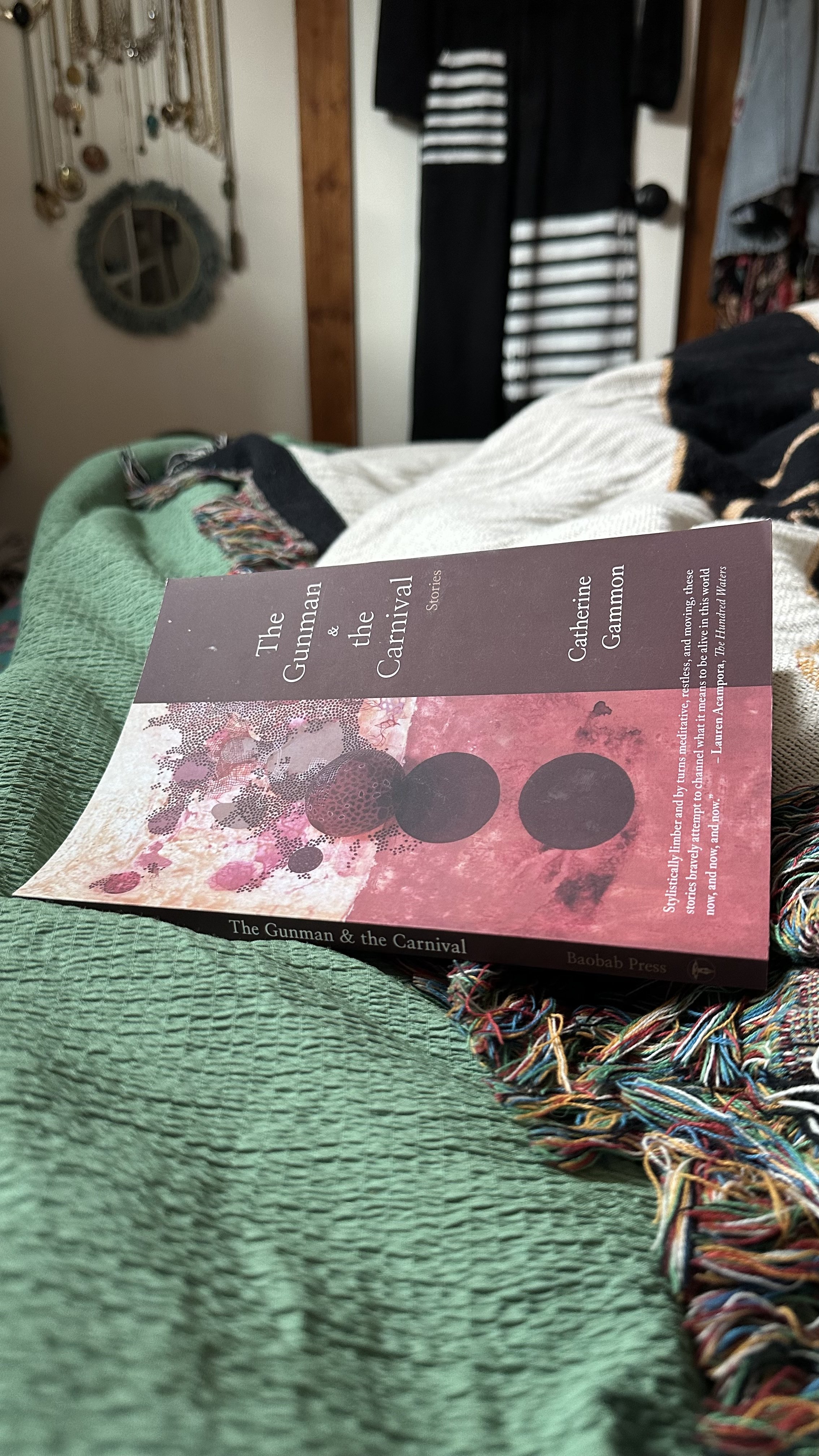
In the post-Thanksgiving lethargy, I was moved to read The Gunman & the Carnival while drinking coffee in bed. I lingered over Gammon’s handwriting and my first name written in proper, hurried cursive. “I hope you enjoy it,” signed, Catherine Gammon.
The coffee never stays warm enough because consuming words fills me up. I reheat in the microwave but the coffee doesn’t taste fresh, and my mouth is bitter with morning breath. The tongue is dirty, and I have a clear mind; the brain a sponge. On page 16, in A Vampire Story?, a single sentence stands out from the rest. “History isn’t destiny.”
Inspiration tickled my creativity but I told myself to keep reading. It is rare to find a book I have read that does not include underlines and highlights and notes in the margins. When I finished the editing certification program at University of Washington, Seattle, in 2018, the editor in me came alive and shadowed the writer in me, who could read for pure enjoyment. I read 11 more pages before scratching the itch. Extracting a single sentence from someone else’s work is a writing practice that helps me mine for deeper understanding of self.
I dialogued with my past,
it is true i feel relegated to past versions of myself, as if i owe her something. she wonders when i will grow wise to my own nature. she sees my tendency to hide and keep secrets—to live up and into another’s ideal silently, accepting the stories they weave and trying to fit herself into them. i am as beautiful as they say, but she never lets it go to my head.
“i couldn’t if i wanted it to,” i tell her.
she nods. “it’s your dad’s fault, and your mom’s, you don’t believe. and what if you could?”
“i know, i know, the blaming ages me. what of forgiveness?”
“you don’t have to give it to them, only to yourself.”
“what’s in it for you?”
“death.”
“i am not ready to die, though i think of it often. i picture what i might look like when i am stiff.”
“death is not rigid.”
“oh, you are going to tell me it is peaceful. you know that only makes me want it more.”
“i don’t blame you. the only way i will disappear is when you forgive yourself for not being perfect. otherwise i will haunt you forever.”
“and forever haunting is something i shouldn’t want? it’s nice to know i will always have company.”
and shared the piece with Gammon.
When the stream-of-consciousness quieted, I emailed Gammon. “I hope an unsolicited share isn’t unwelcome.”
I wondered if she might be interested in discussing writing over coffee or tea, before closing the note with my digital signature. I await response without expectation, only gratitude. Gammon’s discipline to the craft over the years has shown me a glimpse of who I might be when I “grow up,” and I don’t know anything about her journey. I don’t know anything of myself at 80, but I think I want to.
History only informs the future if we are unwilling to change now.